
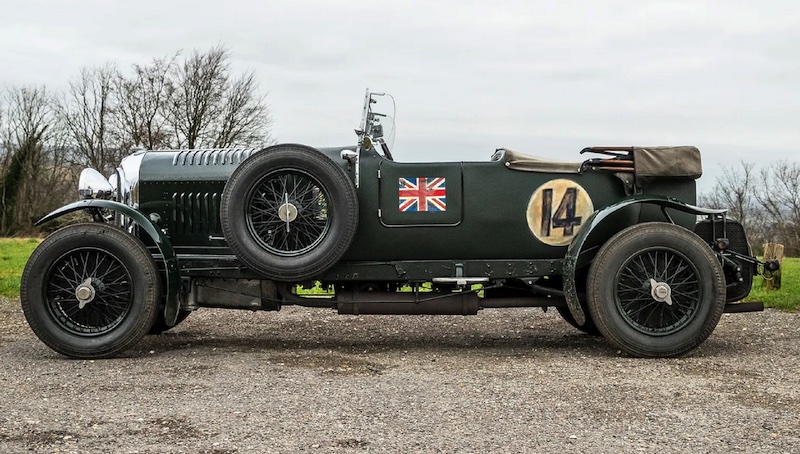
As far back as I can remember, I have always collected something.
And it didn’t matter how valuable that ‘something’ was. Whatever my age, I always wanted to ‘capture’ a certain piece of history to better understand a particular subject in its entirety and ultimately experience the journey between before and after. As a child, I read and collected absolutely everything related to parrots, and later became an amateur psittacidae breeder (which I still do with great passion). Later, I started collecting old books and magazines on civil aircraft and prewar cars. Logic caught up with me again: I became an airline pilot and bought my first prewar car (a 1930 Peugeot 201) at the age of 20. My years as a collector that followed were as rich as they were tumultuous, paved with wonderful surprises but also profound disappointments. C’est la vie!
In the life of a car collector, you buy, trade, keep (most of the time!) or resell depending on how you use a particular vehicle and what you want to do with it. For very specific and personal reasons, there is a particular car or motorbike that one absolutely wants to acquire – far from any form of whim – to restore, pamper and make reliable in order to experience a kind of exhilaration behind the wheel or handlebars. The collector’s playground is vast and limitless.
Beyond the fun and immense pleasure of collecting, I must admit that I have been fortunate enough to meet some absolutely incredible men and women. The fact that I speak both French and English has given me many opportunities throughout my life. Some people have literally inspired or guided me with personal stories worthy of an adventure book. They have given me the desire to initiate or pursue a quest for knowledge because of their own journeys, which are often as unique as they are demanding.
My job has taken me all over the world and, among all my activities during stopovers, I have visited countless automotive museums.
My fondness for vintage Bentleys dates back to the early 1970s. I was six years old and sitting next to a friend of my grandfather’s when I first felt the thrill and attraction of a 1924 Bentley 3 Litre, which this person used as his everyday car. In all weathers and all seasons, its driver – who also owned a Jaguar XK150 3.8 – took his car out on tarmac and dirt roads with equal ease and pleasure! I often accompanied him and clearly remember promising myself that one day I too would experience the pleasure of being behind the wheel of my own Bentley…
And over the years that followed, my adult life revolved around an eclectic collection, not necessarily 100% prewar, consisting of Peugeot 201, Austin 7, Citroën 5HP Type C then Traction Type A, Vauxhall 23/60, Sunbeam 3l Super Sports, Riley Kestrel 14/6, then Riley Sprite and Riley 9 Brooklands, Wolseley Hornet, Ford T ‘Bonneville’ Speedster and Ford A ‘Aero-engined’ Speedster, Alvis Silver Eagle, Jensen 541 Deluxe, Simca 8 Sport, Aston Martin DB2/4 Mk III, ACE Aceca, Lagonda M35 Rapide, Lotus Elite Super 100, Jaguar C-Type (by Lynx), Bugatti 35B, not to mention a few other cars with a pedigree that was sometimes utterly extraordinary. I have always only owned two, three or very exceptionnally four cars at a time so that I can continue to enjoy driving and rallying with them. ‘Drive, drive and always drive’ is the motto of my friend Max, a great enthusiast and developer of prewar vehicles, especially Bugattis! Of course, it hasn’t always been easy, given my busy professional and personal schedule, but I’ve always been able to find a moment that I knew I could turn into an ‘excellent’ moment.
Despite everything, and after so many years, I still hadn’t found my prewar Bentley. Unsurprisingly, it was the Bentley 4½ Litre Le Mans Tourer that continued to fuel my dreams as a privileged spectator at Goodwood, Silverstone Classics, Le Mans Classics, etc. I talked to many owners and gathered all the information I could from books and various publications, particularly those published by the venerable Bentley Drivers Club (BDC). Founded in England in 1936, it is the largest club in the world, with over 4,000 Bentley enthusiasts among its members. From vintage models to the latest designs.
My search lasted more than a dozen years (my wife says I am both very patient and very demanding!), and there were several reasons for this: my budget was not in line with the market, but above all, I had not yet met the right person who would make me an offer for the right car at the right time and in the right place. I travelled extensively and talked to the best specialists in prewar Bentleys (unsurprisingly, they are all in England). I stayed away – as I always have – from pseudo-specialists and unscrupulous sellers, and continued to search without doubting that one day I would find that rare gem.
It was by chance, at the finish line of a Peking to Paris race a few years ago, that I met the man who would sell me the car of my dreams and, in the process, become a true friend.
William Medcalf runs Vintage Bentley in Hill Brow, a peaceful village in southern England ideally located between Goodwood and Brooklands, the two temples of British motorsport. For over 30 years, Vintage Bentley has been an internationally recognised authority in the restoration, sale and maintenance of 100% original Bentleys manufactured exclusively between 1922 and 1932 (1931-1932 was the period when Rolls Royce bought Bentley, which was then in serious financial difficulty). If you are looking for a Bentley built after 1932, William will invite you for a beer but will quickly and politely tell you that you have come to the wrong place!
Vintage Bentley has just over 30 employees, including around 20 highly qualified technicians, engineers and toolmakers, who are involved in major international events such as Le Mans Classic and Goodwood, as well as some of the world’s most challenging endurance rallies, such as Peking to Paris and the Flying Scotsman. William Medcalf and his team offer virtually unlimited logistical and mechanical support to their customers!
When I shook William Medcalf’s hand in Paris, I already knew that I was going to be talking to a true ‘Bentley Boy’, deeply involved in the living history of Bentley. It was at Pebble Beach in the USA a few years earlier that I had spoken to a Bentley WO owner who told me that there was only one person he would trust with his car: William Medcalf. I remember telling him that there was an ocean between the United States and Great Britain and that it couldn’t be easy to transport the car back and forth. With a hearty laugh, he replied in all seriousness, ‘You have to know what you want in life.’
On the day of the Peking-Paris race’s arrival, it was a 1929 Bentley 4½ Litre prepared by William Medcalf’s team that took the top spot on the podium after a 16,000 km race. Since 1907, this car race has been the most gruelling of all, for both the cars and their crews. It crosses half the globe and anything can happen! The first handshake with William was sincere, and as our eyes met, I had the strange feeling that we had both grasped, at the same moment, that tiny, indefinable second that we call trust. His approach was one of humility and simplicity: that of a car enthusiast chatting quietly with another enthusiast of the same cars. You can guess what happened next.
Two years passed, and William and I were in regular contact, with the discreet but very effective presence of the company’s sales director, Anna Wilkinson.
A 4½ Litre Le Mans Tourer that met my expectations was identified. I was immediately captivated by the car’s rich history since it left the factory on 14 April 1928. Six months later, after a test drive and a service in the workshop, I shook William’s hand as “YU1198” (its historic registration number) joined our family on a famous 14th of October (perhaps one day I’ll tell you a few details about the number 14, which has always been important in my life).
YU1198 was imported physically and fiscally without difficulty thanks to the excellent work, support and meticulous attention to detail of Vintage Bentley. I sent all the technical documents required by the FFVE (Fédération Française des Véhicules d’Epoque – or to be literally translated by French Federation of Vintage Vehicles) and within less than two weeks I received the official historic vehicle certificate for YU1198 by email. Once again, the FFVE has shown me great professionalism, speed and diligence, despite what its detractors may say. French collectors are incredibly lucky to have the FFVE on their side.
YU1198 arrived from England at the end of a particularly gloomy winter day, as is often the case in Normandy at this time of year. At 20:00, I decided to go for a nice ride in the headlights to welcome YU1198. I had opted to do a short warm-up of about ten kilometres. Caught up in the thrill of the moment, I ended up returning around 22:00 in a daze, having covered a hundred kilometres in the end! I stopped by the Seine River to let YU1198 cool down. Under the glow of a street lamp, I took the time to caress the incredible curves of our Bentley 4½ Litre with my hand and found myself talking to our new car to thank her for this wonderful moment.
The generous proportions of the 4½ Litre model had been strongly criticised by Ettore Bugatti after another defeat for his cars at the 24 Hours of Le Mans. The Bentley team was celebrating its fifth victory there (1924, 1927, 1928, 1929 and 1930). In annoyance or irritation, Ettore Bugatti declared, ‘They are the fastest lorries in the world.’ This was not the most accurate assessment by the brilliant manufacturer.
I was fortunate enough to own a Bugatti 35B for many years before becoming the last custodian of YU1198. There is no comparison between the two cars. The Bugatti weighs approximately 700 kg (1,550 pounds) and has a 2.3-litre engine delivering around 130 horsepower, while our Bentley weighs slightly more 1,700 kg (3,700 pounds) and is powered by a 110-horsepower engine with a displacement of 4.5 litres. Yet both cars are absolutely fantastic in their respective roles.
The Bugatti 35B is an iconic ‘sprint’ or ‘rally’ car, where it has historically excelled thanks to its responsive and agile handling. The melody of its engine is captivating and will make you lose your mind. A soft drug one second, a hard drug the next. On the other hand, the maintenance of the Bugatti 35 has always been a topic of discussion, and one must be both cautious and very attentive to its day-to-day operation.
The 4½ Litre was designed by Walter Owen (W.O.) Bentley with a different goal in mind: to make it legendary for its robustness and reliability in endurance racing. Bentley’s victories at the 24 Hours of Le Mans and other endurance races in England prove that this goal was not only achieved but exceeded. And for eternity. 100 years later, it is still the 4½ Litre model that continues to perform valiantly in the Peking to Paris race and other particularly demanding long-distance competitions. And that’s what I like about YU1198: its versatility is limitless. You can drive all day in a rally and then set off again in the evening for a leisurely drive to a good restaurant. With a flick of the ignition switch, our almost century-old car springs to life again, as if to say, ‘Are we off again already?’ Maintaining it is no surprise. My late friend Adrian Van der Kroft, a great collector of the brand, once said to me with a twinkle in his eye: ‘The Bentley 4½ Litre is actually a draught horse with the capabilities of a racehorse. This car can do everything quickly and well!’
It was very late when I finally closed the garage door of our house and wished YU1198 good night. As I walked away, I heard a little voice say to me, ‘Good job Ludo. This is the beginning of a long story.’