
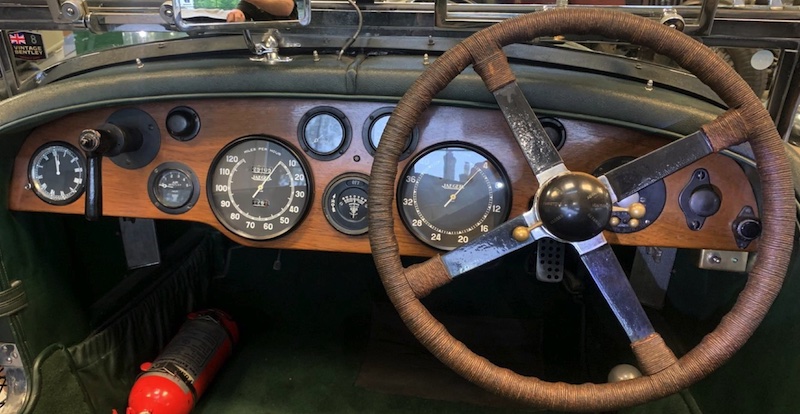
The dashboards of Bentleys produced between 1922 and 1932 range from a certain minimalism (in the early 3-Litre models) to a degree of complexity (particularly in the 4½ Blower model).
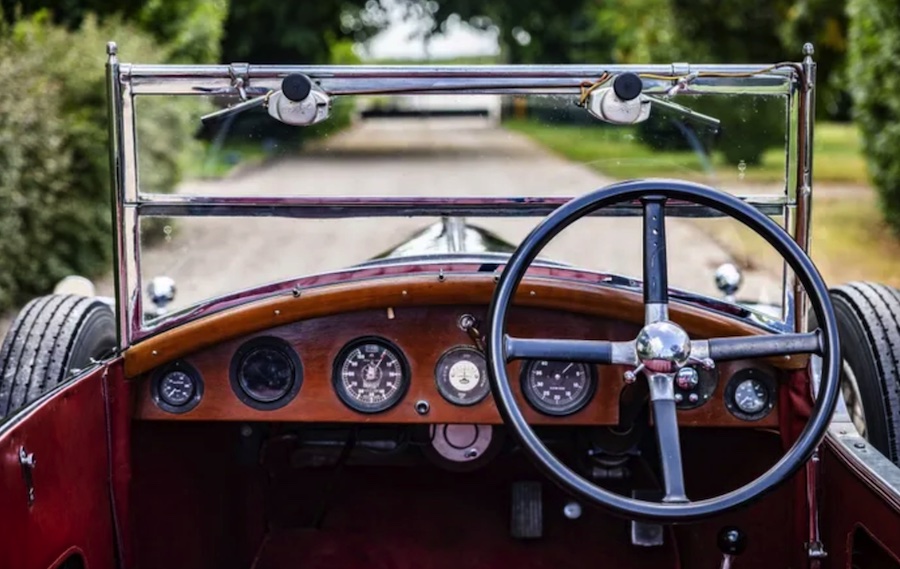
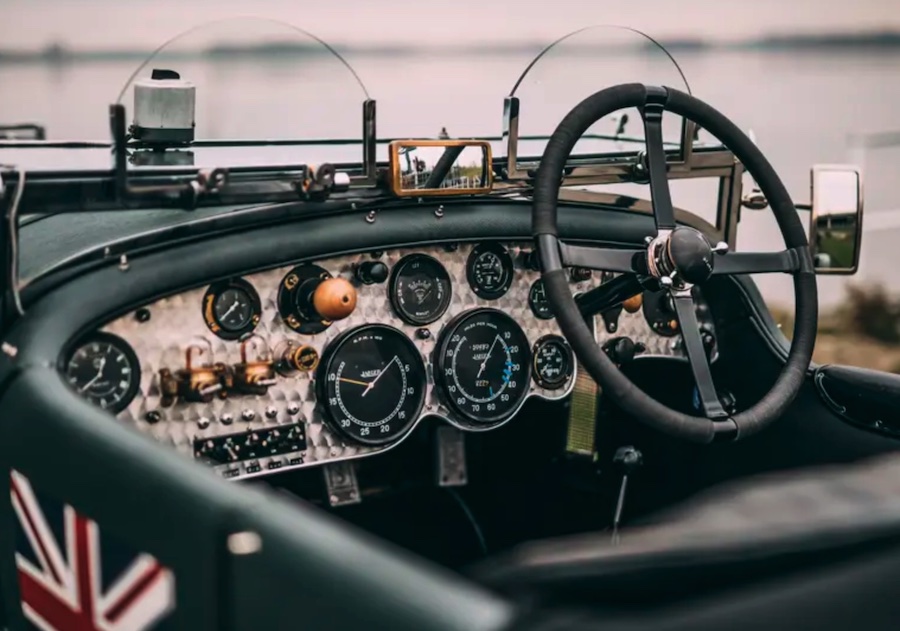
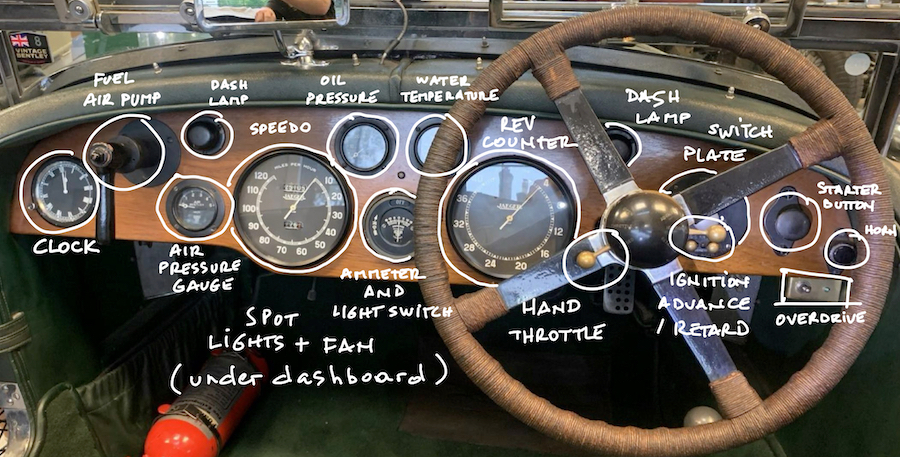
Our car – YU1198 – was produced in April 1928 and its dashboard remains relatively compact in design: the information provided by the instruments is easy to read and the controls associated with these instruments are readily accessible from the driver’s seat.
I’ve spent a good part of my life in aircraft cockpits, so I naturally pay a fair amount of attention – or perhaps even a great deal of attention – to the dynamic environments in which I find myself.
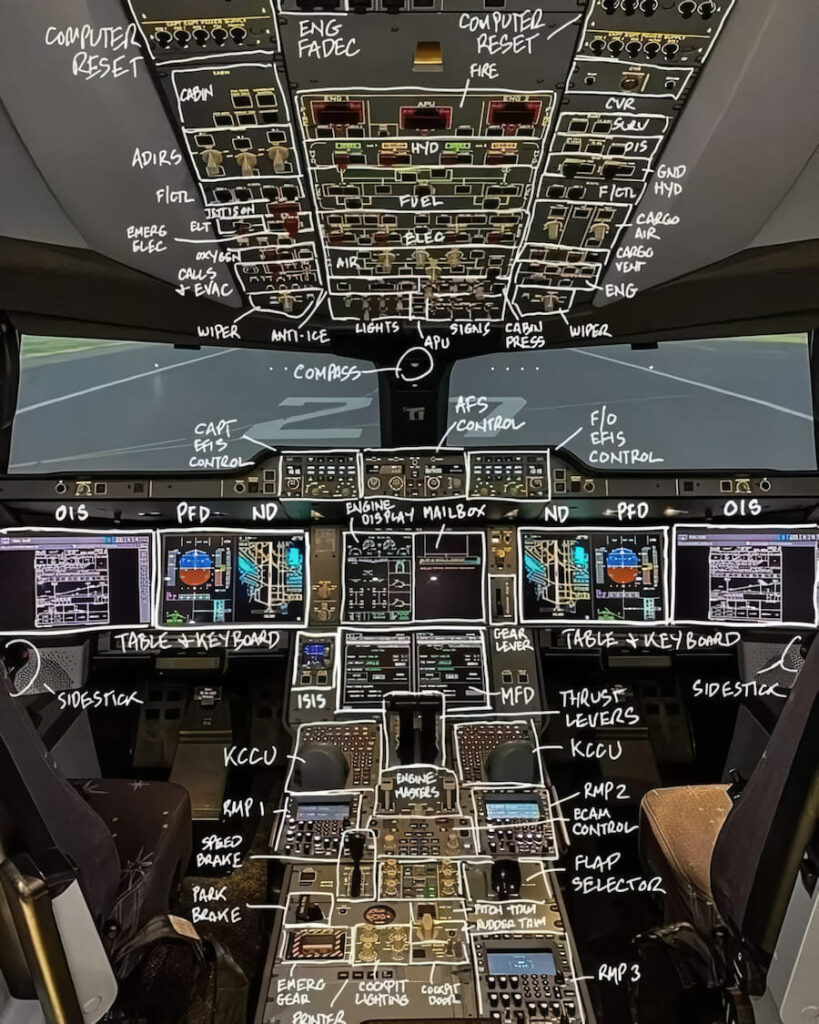
The seating position and how my 6 ft fit in the YU1198 are just perfect! The only two things that are a bit confusing are the position of the gear lever on the floor, which rubs against my right leg, and the centrally positioned accelerator throttle (a sort of ‘big button’ or ‘mushroom’ between the clutch on the left and the brake on the right)! But after a short period of adjustment, you get used to it quite easily. I’ll come back to this in another article.
The dashboards of vintage Bentleys were overwhelmingly made from various types of wood: one very often finds cedar, white ash (this wood was very hard and straight grained), or oak, very lightly varnished, but also other, sometimes “more unexpected” combinations over the years. Corked aluminium dasboards, which had already been used on Bugatti Type 35s from 1924 onwards, began to appear in the late 1920s on a few Bentley models specially prepared by the factory for competition, and later on certain Blower models such as those produced by Tim Birkin’s teams, independently of Bentley Motors (read the article “W.O. for eternity”). These corked aluminium dashboards are now often found in vehicle restoration projects to give the whole car a “sleek” look.
It is important to remember that Bentley Motors, like all other car manufacturers of the time, supplied their customers with nothing more than a rolling chassis (with an engine and a few accessories). It was the buyer’s responsibility to choose the bodywork and all related accessories from specialist coachbuilders. The dashboard was therefore fitted out by the coachbuilder and under no circumstances by Bentley Motors. Over the course of the car’s life and through its various owners, the dashboard might also undergo certain modifications.
This is a point that is often overlooked when it comes to vintage Bentleys, but the average number of owners between the car’s factory release in the 1920s and today is often around fifteen. This is hardly surprising for century-old cars that may have led a thousand lives, marked by grandeur but also by hardship! My wife and I, for example, are the tenth owners of YU1198.
I recently saw a 4½ Blower (which became a Blower in 1987, to be more precise) at Silverstone that has had 24 owners since 1930, whilst I also had the chance to take a spin in a Bentley 3-litre model that has had just… two owners: father and son! The father drove his car right up until the age of 95.
The instruments on the YU1198’s dashboard are a mix of Jaeger and Smiths brands, whose names appear on the faces of the instruments. The two manufacturers came together under a single production entity in 1929, when the British company S. Smith and Sons acquired Ed. Jaeger Ltd., which had been founded a few years earlier in London by the watchmakers LeCoultre (Switzerland) and Jaeger (France) to manufacture instruments for prestigious car manufacturers and circumvent the protectionist measures imposed by the British government at the time.
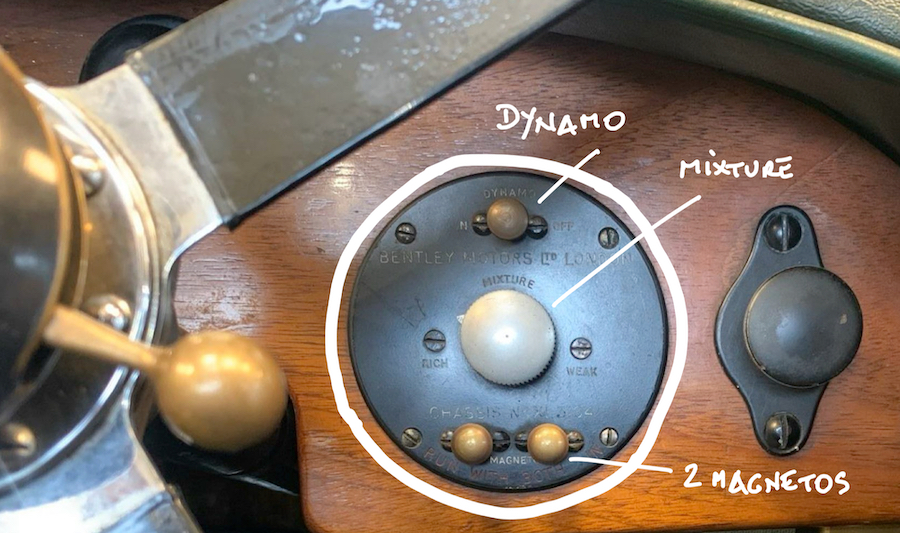
There are two exceptions to this mix of Jaeger and Smiths components on the YU1198’s dashboard: the instrument lighting is provided by two “Homa” dash lamps, whilst the horn and its control on the dashboard are German-made, specifically from the Bosch brand. One might wonder about the brass plate, obscured in the photo but to the right of the steering wheel (see picture above), known as the ‘switch plate’ and bearing the inscription ‘Bentley Motors Ltd London’. This ‘switch plate’ houses the dynamo switch (now often replaced by an alternator), the mixture (or choke) control and the two magneto switches.
Despite the inscription “Bentley Motors Ltd – London” (which also includes the car’s chassis number – in this case “XL 3104”) – which might suggest that Bentley produced a set of “in-house” components, (dynamo, mixture and magnetos), all components except the plate itself (produced by a Bentley subcontractor) were in fact manufactured by Smiths. Incidentally, in 1930 Smiths sold its M.L. Magneto Syndicate Ltd. brand to its competitor Lucas, another major supplier to the British automotive market (dynamos, magnetos, alternators, ignition systems, headlights and other indicator lights, electrical connectors, etc.).