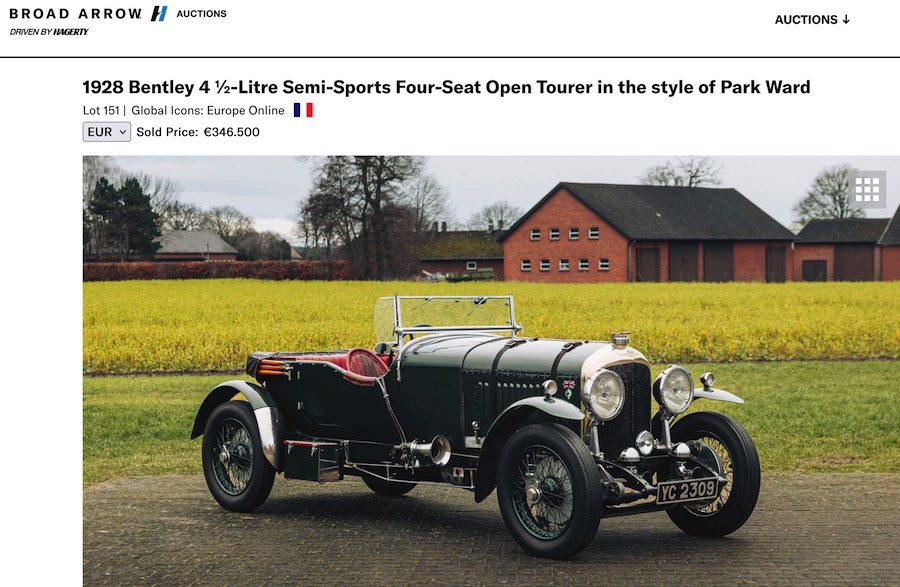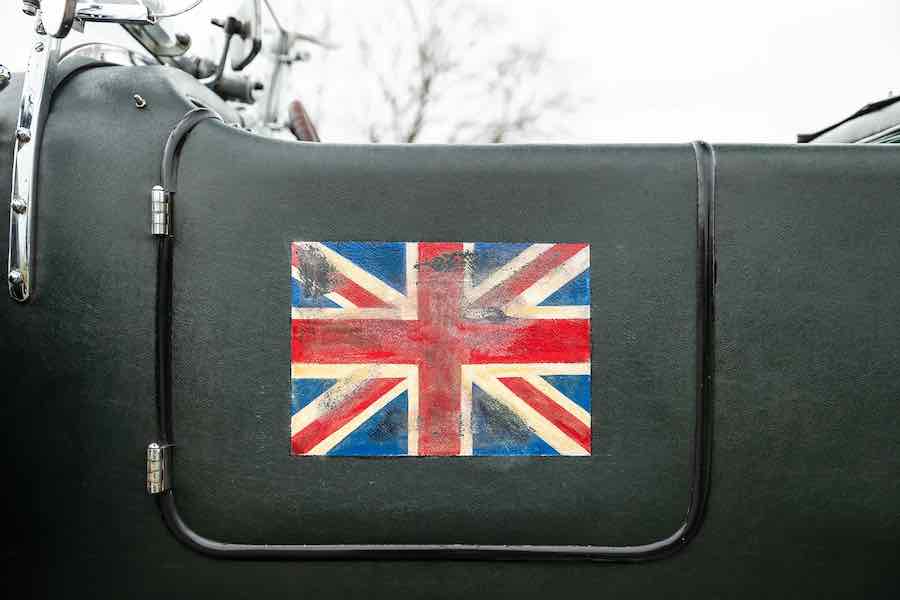
This is one of the most confusing areas of terminology relating to vintage Bentleys, as the terms “Tourer”, “Open Tourer” and “Sports Tourer” were used rather loosely in the 1920s, and the situation has not improved over time!
A car’s specific identity, as we understand it today, was very different back then. Buying a car was not a ‘one-stop shop’: from 1919 to 1940, all Bentleys which left the factory – either Cricklewood up to 1932 and Derby from 1933 until the Second World War – were delivered as rolling chassis (with an engine and a few accessories) to the customer’s chosen coachbuilder, there to be fitted with a unique body and upholstery of their choice. For the record, the first Bentleys to be built complete with a standard body design were the first Mk VIs, which started rolling off the new production line at the Crewe works in 1946. However, customers could (if they so chose) and still can request customised variations from a coachbuilder.
The list of coachbuilders could be extensive depending on the models offered by Bentley, but in the case of the 4½ Litre, the work was mainly carried out by Vanden Plas, H.J. Mulliner, Harrison and Sons, Gurney Nutting, and Freestone & Webb. There were a few others, but their creations, although of high quality, were in the minority. Unsurprisingly, these coachbuilders gave different names to their body styles, and a body style listed in the catalogue as “Tourer” by one coachbuilder might be sold with the same specifications as an “Open Tourer” by another. Later restorations / rebodies have also caused a fair amount of confusion (whether intentional or not) by altering these descriptions over time – in order to draw attention to it.
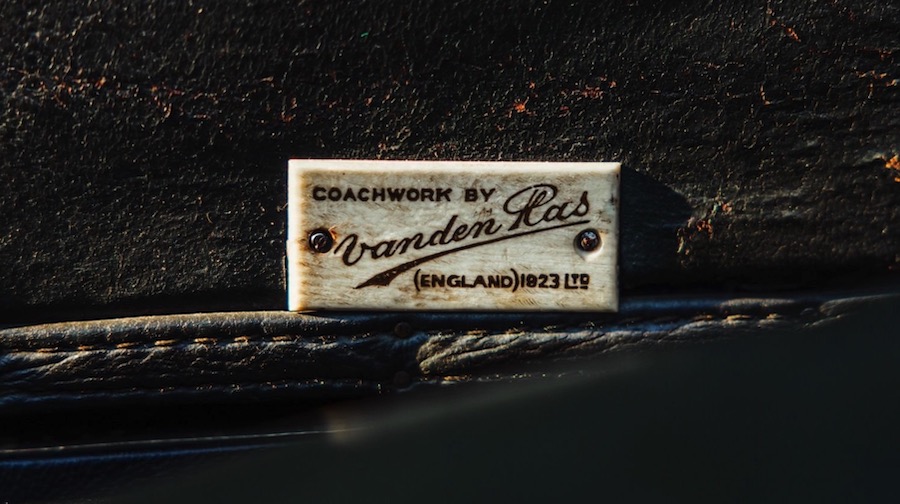
I spent years looking for a 4½ litre model before finally finding the right one. I met lots of friendly and often interesting people, but I also came across, from time to time, a few sellers – both private individuals and professionals – who seemed determined to pass me off a sausage as a Rossini steak! We all know that there are professional storytellers in the world of vintage Bentleys and more generally, in the classic car trade: how many times have I heard stories that could have begun with ‘once upon a time’? How many times did I read or heard “The body is believed to be by Vanden Plas” or “the car was rebuilt in the Vanden Plas style in the early sixties” or “It is believed that this Bentley was rebuilt around a historic Vanden Plas body by the well-known specialist for Bentley prewar vehicles…”
From a historical perspective, it is worth noting that half of the 4½ Litre models were “dressed” by coachbuilders as “Saloon” cars (a “saloon” in British English meant what Americans would call a “sedan”: a fully enclosed passenger car with a fixed roof). As for the other half, these were models known as ‘Tourers’ or ‘Open Tourers’, but mainly marketed by coachbuilders under the names ‘4 Seat Sports’ or ‘2 Seat Sports’. But it was not uncommon to see the vehicle’s appearance change according to the whims of each new owner and the vehicle’s intended purpose at the time. How many “Saloon” cars became “Tourer”, “Open Tourer” or “Sports Tourer” amongst Vintage Bentleys? A lot! This reached its peak from the mid-1970s onwards, when “Le Mans” bodywork, inspired by Bentley’s successes between 1924 and 1930, really muddied the waters!
When Vintage Bentley invited me to test drive YU1198 for the first time, I was particularly impressed by the comprehensive set of historical documents that came with the car. It is thanks to the three voluminous files containing over 250 documents – including purchase and maintenance invoices, a wealth of correspondence and photographs (at a time when emails obviously did not exist and written communication still took precedence over the telephone) – that we were able to gain a better understanding of the incredible history of this 4½ Litre.
Chassis “XL3104” officially left the Bentley Motors factory in Cricklewood on the 14th of April 1928, to be driven just 5 miles away to the workshops of coachbuilders Harrison & Sons. The family company was listed as a maker of “motorcar bodies” as early as 1906, having been founded as coachbuilders in 1883. Through the ’twenties Harrison & Sons bodied a number of top of the range chassis of various makes as well as over 200 Bentleys, but the company went out of business in 1931, the same year that Bentley went into receivership.
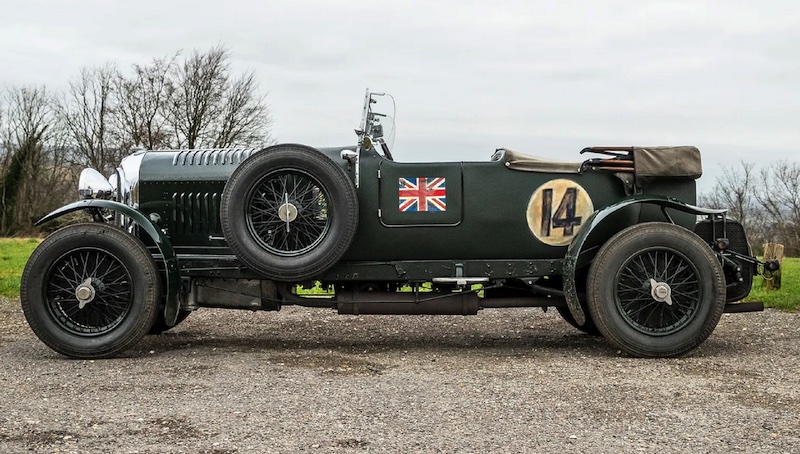
The first owner of our 4½ Litre was Major Charles Perkins and the car was initially registered “YV9918”. Major Perkins was a veteran of the First World War and he was managing director of Barclays, Perkins and Co, Ltd, a brewery headquartered in Park Street, London.
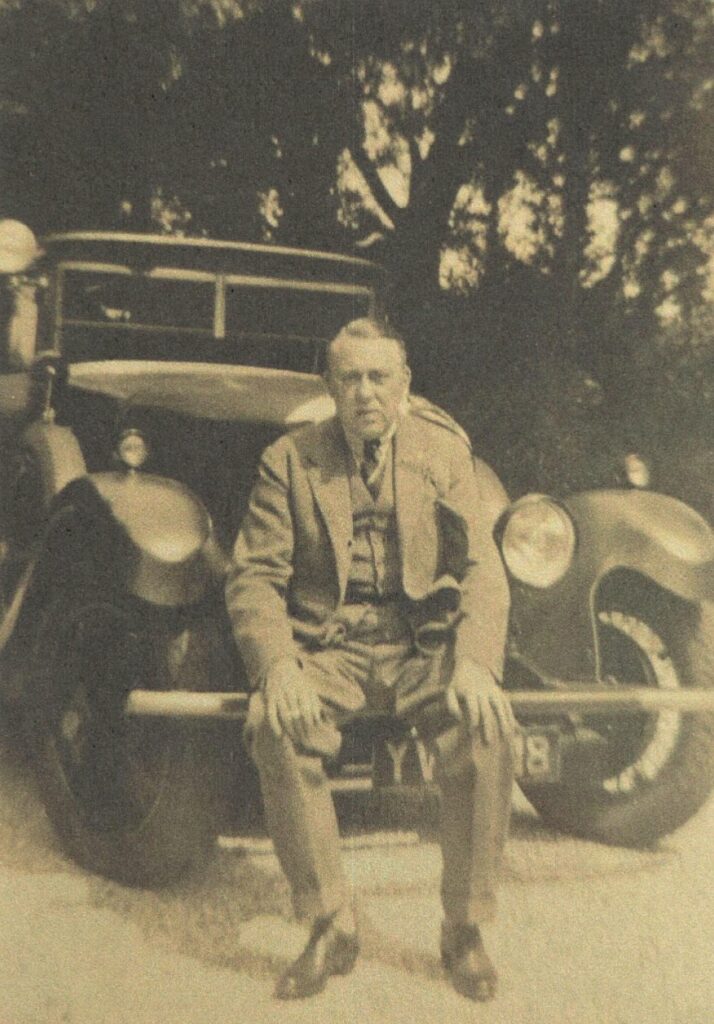
The original body chosen by Major Perkins was the standard catalogue Harrison & Sons model “British Flexible two/four seater saloon”, with full length wings, twin side mounted spares and folding luggage grid to the back. As there are no records from Harrison & Sons, the colour scheme was probably black with brown furniture hide upholstery from new. Major Perkins paid a total of £ 2,250 (chassis only £ 1,050 + Harrison & Sons body £ 1,200), about 10 times the average house of price of £ 250 at that time.
The second owner, William Gurney Smeed, purchased the car in November 1936. He was a keen collector of Bentley cars and was a member of the very recently formed Bentley Drivers Club (BDC). By 1936 he had owned two 3 litre models, three 4½ Litre, one 4½ Litre Blower, a Speed Six and an 8 litre!
In March 1937, the car’s body was converted into an “Open Tourer”, though it is not known exactly which coachbuilder was responsible for this work. The car appears to have been little used until Britain’s entry into the Second World War.
At the end of the war, the car was purchased in October 1945 by Lieutenant Colonel Norman Barry, who had notably served in North Africa. On the 4th January 1946 the “Autocar” magazine published an article written by Lieutenant Colonel Norman Berry in which he describes his ownership of YV9918. Reading this article offers an interesting insight into how this Bentley 4½ Litre might have been used at the time.
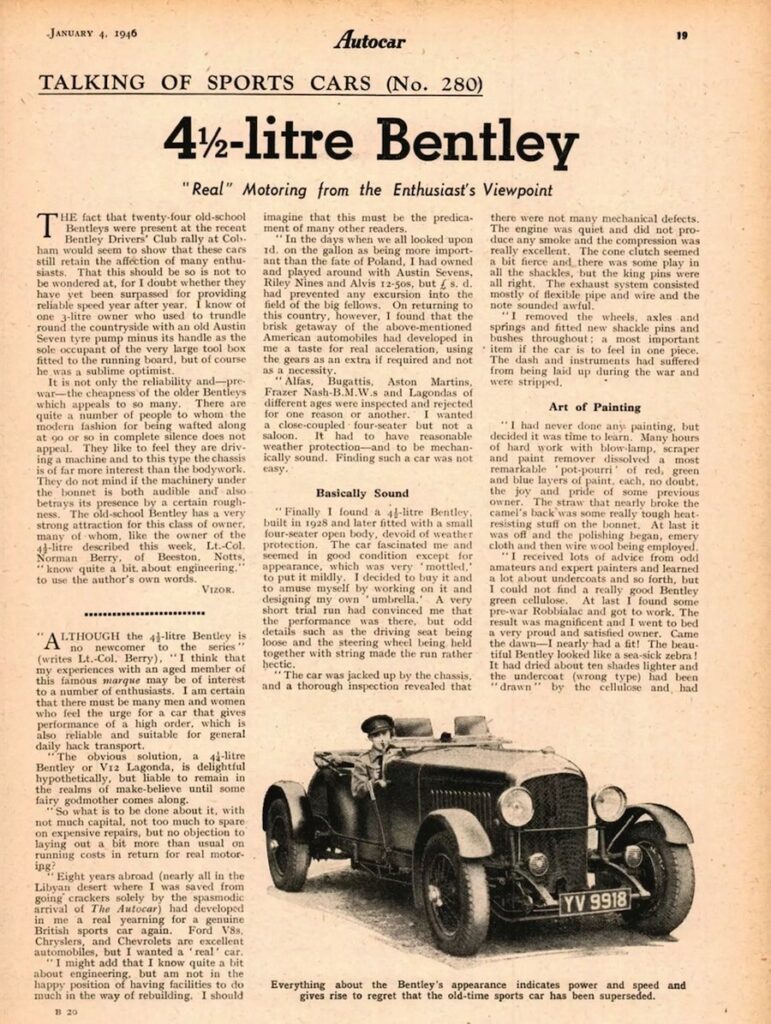
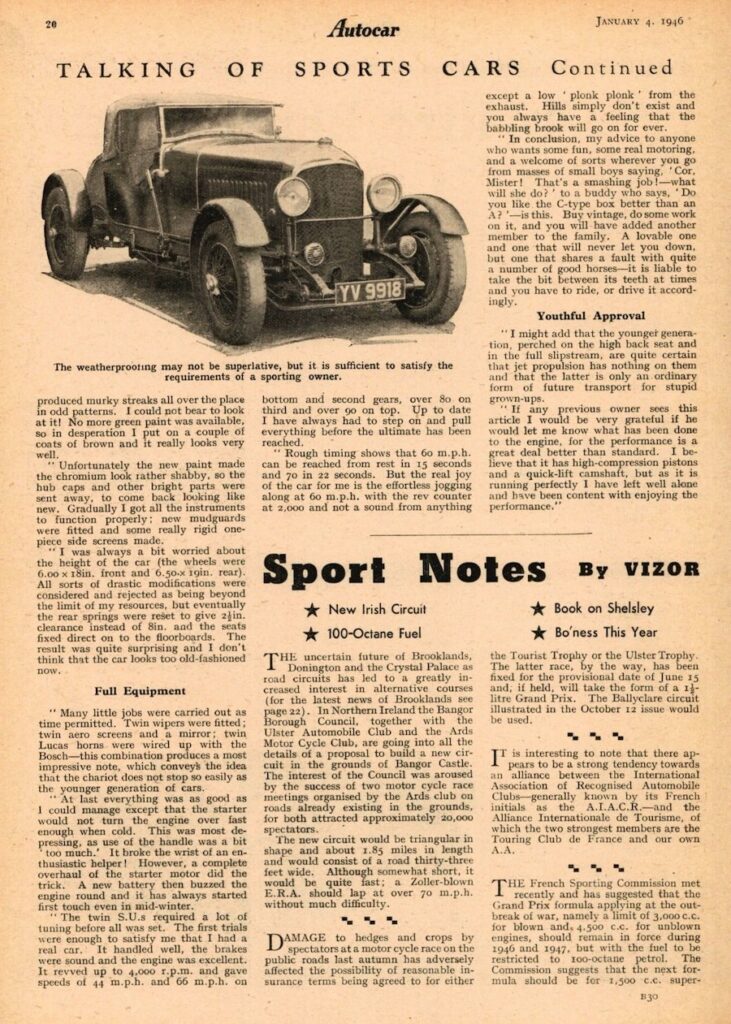
Shortly afterwards, YV9918 passed into the hands of racing driver Jack Fairman who, participated after the war in some of the most notable achievements of British sports cars, in both Jaguars and Aston Martin. He drove in several of the Le Mans 24-hour races of the 1950s and was part of the team which drove a Jaguar XK120 at a record-breaking average speed of more than 100mph for a week. Lately in the 1950s, Jack Fairman gained a reputation among formula 1 owners as a works test driver and became much involved in the development of the formidable D-type Jaguar.
In 1954, the car’s registration was changed to YU1198 under its seventh ownership with Edwin Trapp, who was a businessman and also secretary of the Eastern Regional Board for Industry. Mr Tapp’s family have confirmed that YU1198 was stored under tarpaulin alongside other cars from the late 1950s until 1983 when the car was sold to the famous Stanley Mann – before being immediately bought by Michael Wilson, a chartered accountant living in London. The car was entrusted to H&H Coachbuilders, Dick Brockman and Geoff Huckle from G.A Huckle, who carried out together a conversion from an “Open Tourer” body to a “Le Mans” Body.
The interior was reupholstered in dark green Connolly leather and a Le Mans petrol tank was installed during the summer of 1983. A Laycock overdrive unit and an alternator were also installed in 2004 by Elmdown Engineering Ltd.
Michael Wilson was a meticulous and very attentive owner, ensuring the car was maintained to the highest standard, for over 30 years before his son inherited YU1198 in 2013. The car was then entrusted to Vintage Bentley, William Medcalf ‘s company. Ten years later, my wife and I became the final owners of this incredible, almost century-old 4½ Litre, which is still going strong!
Whilst the chassis, engine, differential & banjo, gearbox, crankcase, magnetos, steering column, brakes and suspension are all strictly original and stamped with the chassis number, It took us a while to get to grips with the three different body styles that have shaped our car’s three distinct ‘personalities’!
Let’s now return to our initial question: “What are the differences between a Tourer, Open Tourer or Sports Tourer Bentley 4 ½ Litre?”
Tourer
The specific term “tourer” became widely established in Britain in the early 1900s, especially around 1903–1905. Coachbuilders and manufacturers used it descriptively rather than as a trademarked model designation. Early British and European car builders using the terminology included Daimler Motor Company, Napier & Son, Rolls-Royce, Bugatti, Panhard et Levassor etc.
During the 1920s, the “Tourer” designation simply meant an open-bodied car designed for road use and long-distance motoring. This term should be regarded as the British equivalent of a ‘Phaeton’ or ‘Touring’ for American cars, and of a ‘torpedo’ for French cars.
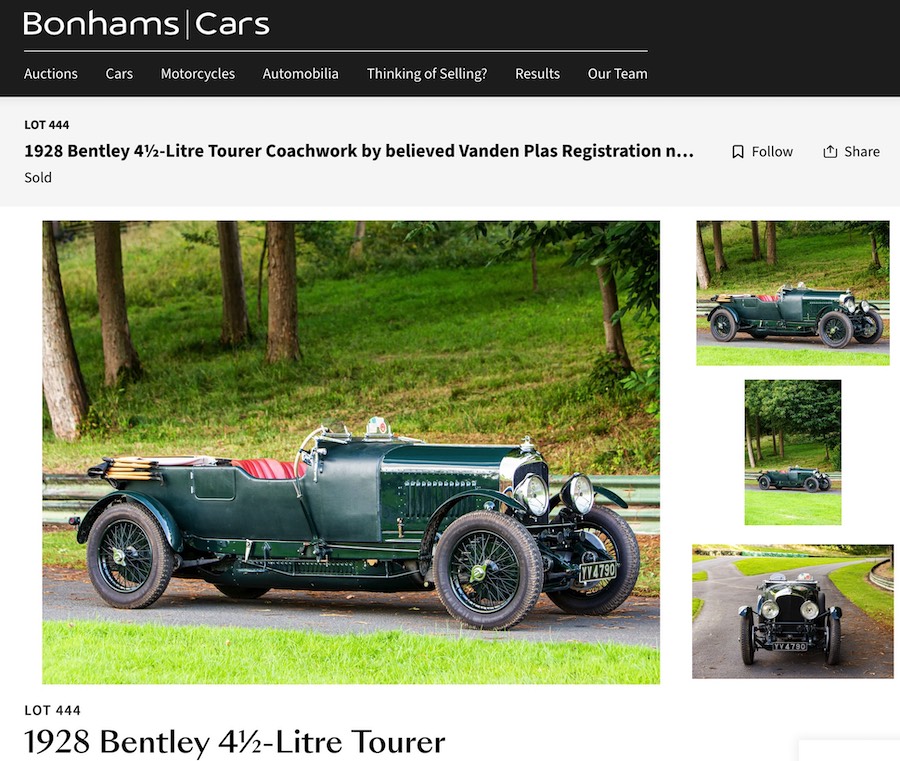
A Bentley 4½ Litre “Tourer” usually had:
– Two or four seats
– Folding roof
– Full windshield
– Weather equipment
– More civilized trim for road touring.
It did not necessarily imply sportiness and lightweight construction.
Open Tourer
One of the earliest surviving documented uses resembling the fully standardized phrase is found on cars such as the 1906 Spyker 14/18 HP “open tourer”.
There is usually little to no formal difference between a “Tourer” and an “Open Tourer.” Car sellers, auction houses, and historians often use the term interchangeably with “Tourer.” An “Open Tourer” is basically a clarification term, just a more explicit way of saying the car has an open passenger compartment with a no fixed roof and sometimes a folding soft top.
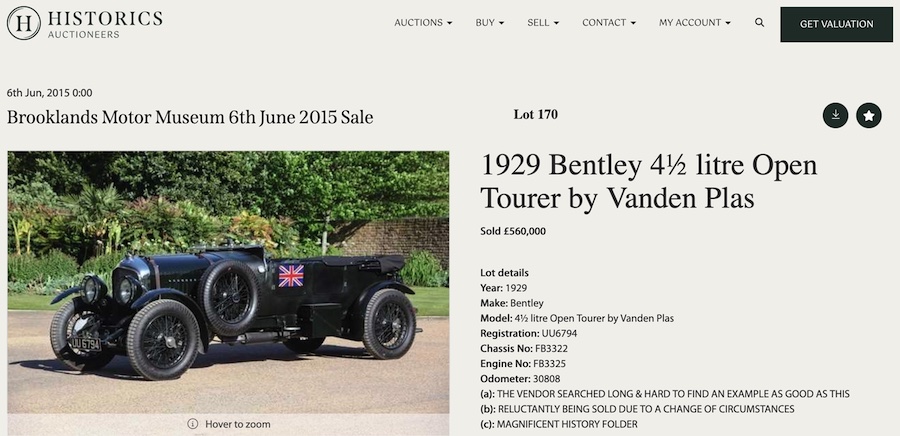
Just Like the “Tourer” word, “Open Tourer” does not automatically mean:
– Lighter weight
– Sportier setup
– Racing influence
– Lower bodywork.
Sports Tourer
This is where things become more distinctive. A “Sports Tourer” generally implied:
– Lighter bodywork
– Sportier seating position
– Brooklands-style windscreen
– Cut-down doors
– Minimal weather protection
– Styling inspired by Bentley’s Le Mans Works cars.
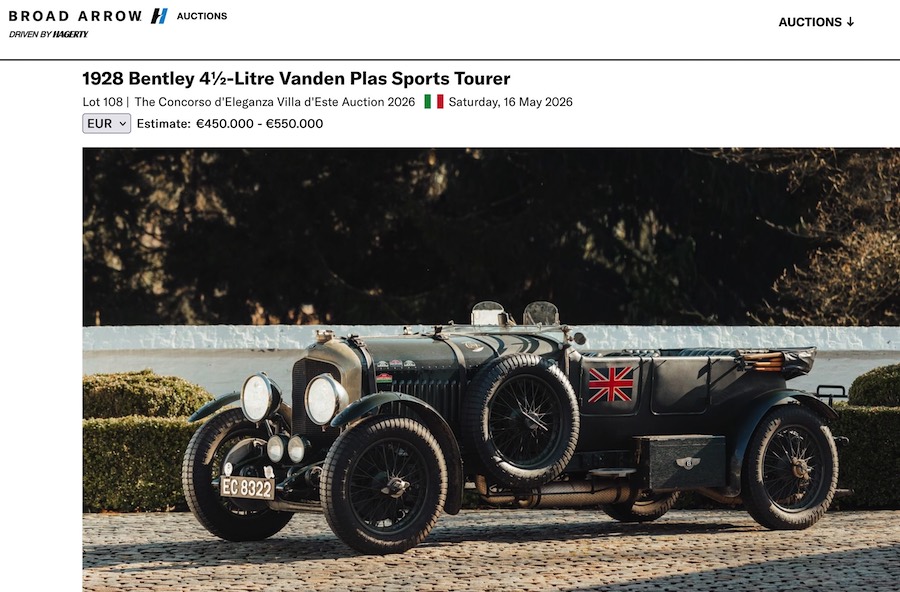
The specific “Sports Tourer” designation first appeared in 1923 for the Bentley 3-Litre model bodied by Vanden Plas. The best-known Sports Tourer bodies for the 4½ Litre came from Vanden Plas, H. J. Mulliner, and Gurney Nutting.
The science of marketing had certainly not yet emerged, but salespeople already knew how to attract all kinds of potential buyers, especially those who wanted more civilized fast touring cars. In the early months of 1928, coachbuilders began using labels like “Semi-Sports“, “Semi-Sports Tourer”, “Sports Saloon” to indicate bodies that retained sporting style but added comfort and weather protection.
Enough to cause even more confusion among future custodians almost a century later!