
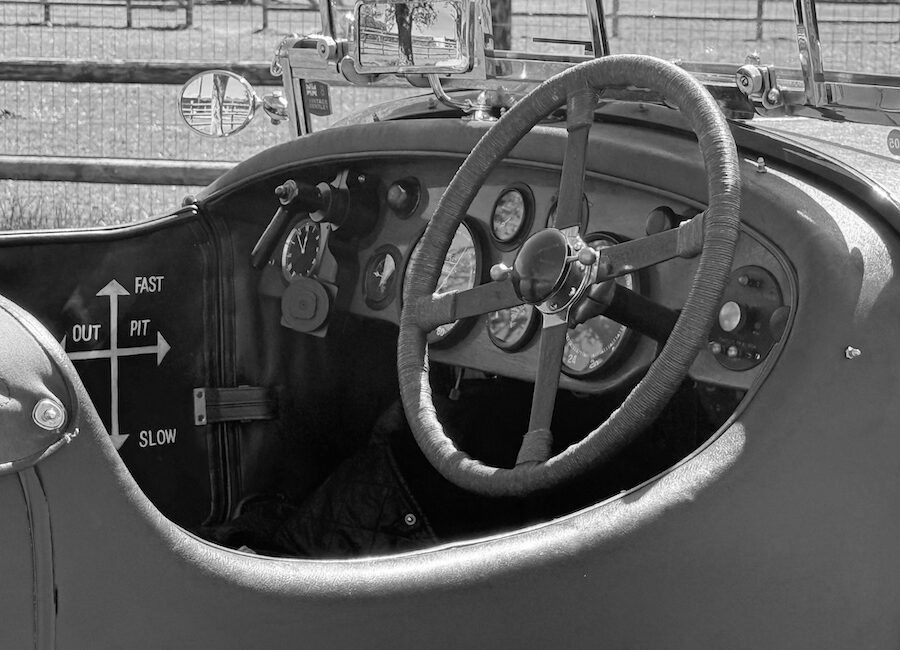
Why were car steering wheels originally fitted on the right, and why have they remained there in some countries while moving to the left in others?
Today, the position of a car’s steering wheel seems entirely obvious. In most European countries, throughout South America, in the United States and in many other parts of the world, it is on the left (with traffic driving on the right). In the United Kingdom, Ireland, Malta, India, South Africa, Japan and Australia, the steering wheel is on the right (with traffic driving on the left). Yet in the early days of the motor car, this arrangement was far from standardised. More surprisingly still, many European cars – including French, German and Italian models – were originally built with the steering wheel on the right. Why was this the preferred arrangement? And why did some countries later adopt left-hand drive while others retained right-hand drive?
THE LEGACY OF THE HORSE-DRAWN CARRIAGE
To understand this evolution, we need to go back several centuries before the arrival of the motor car.
As most people were right-handed, horsemen traditionally mounted their horses from the left so as not to be hindered by the sword worn on their left side (allowing it to be drawn more quickly with the right hand!). It therefore became equally natural to keep to the left-hand side of the road, enabling a rider to pass a stranger while keeping his sword between himself and the other person.

This habit continued with stagecoaches and horse-drawn wagons. On large teams, the coachman would often sit on the left-hand horse of the rear pair in order to handle his whip with his right hand. This position naturally favoured keeping to the left-hand side of the road, making it easier to judge the clearance when passing vehicles approaching from the opposite direction.
The United Kingdom also formalised left-hand traffic at a very early date. As early as the eighteenth century, London regulations already required traffic to keep left, and in 1835 the Highway Act extended the rule to all British roads. By the time the motor car appeared, no one considered altering a system that was already firmly established, so fitting the steering wheel on the right was perfectly logical.
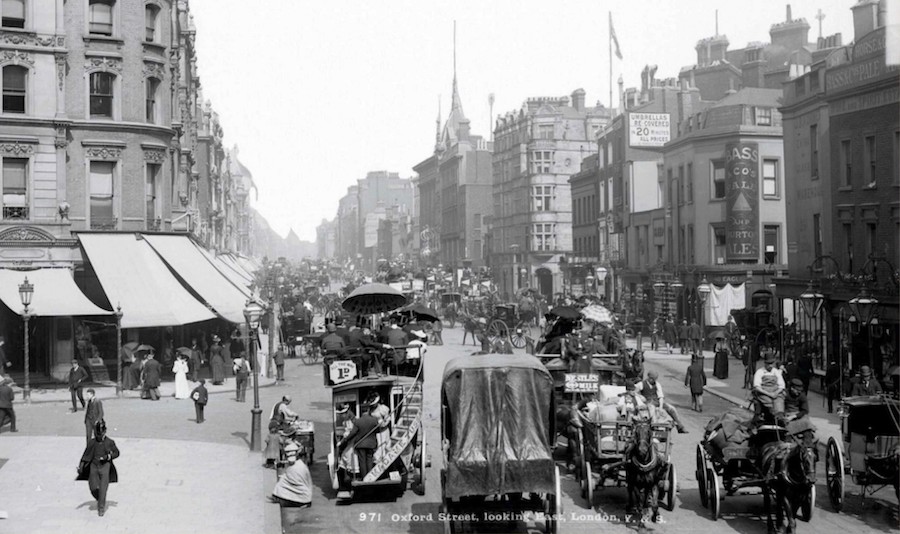
In continental Europe, it was Napoleon Bonaparte who played a decisive role. Until then, military tactics generally required attacks to begin against the left flank of the opposing cavalry. Napoleon, however, chose to rely on surprise by ordering his troops to attack from the right. Following a series of victories, he imposed right-hand traffic throughout the Empire. As French conquests spread across Europe, many territories adopted the same rule. After Napoleon’s downfall, most retained it, as changing once again would only have created confusion.
During the twentieth century, the influence of the American motor industry, where cars were designed to drive on the right with the steering wheel on the left, reinforced this standardisation.
A MATTER OF VISIBILITY
The first motor cars appeared during the 1880s and 1890s, at a time when no international standard existed regarding the position of the steering wheel. Contrary to popular belief, the choice of which side to place it on was not yet determined by the direction of traffic, but primarily by visibility.
Roads at the time were narrow, unpaved and often bordered by ditches. Pedestrians and cyclists were numerous. Overtaking was uncommon, but passing oncoming vehicles required great precision. Drivers preferred to sit on the side nearest the centre of the road, making it easier to judge the distance to approaching traffic.
Thus, in countries where traffic kept to the left, the steering wheel was naturally placed on the right. In countries where traffic kept to the right, however, many manufacturers nevertheless chose right-hand drive because speeds remained low and judging the edge of the road was considered less important than judging oncoming traffic.
This explains why many French cars built before the First World War – such as De Dion-Bouton, Panhard & Levassor, Renault and Mors – still featured right-hand drive. Bentleys, Hispano-Suizas, Rolls-Royces and Mercedes of the same period followed the same principle.
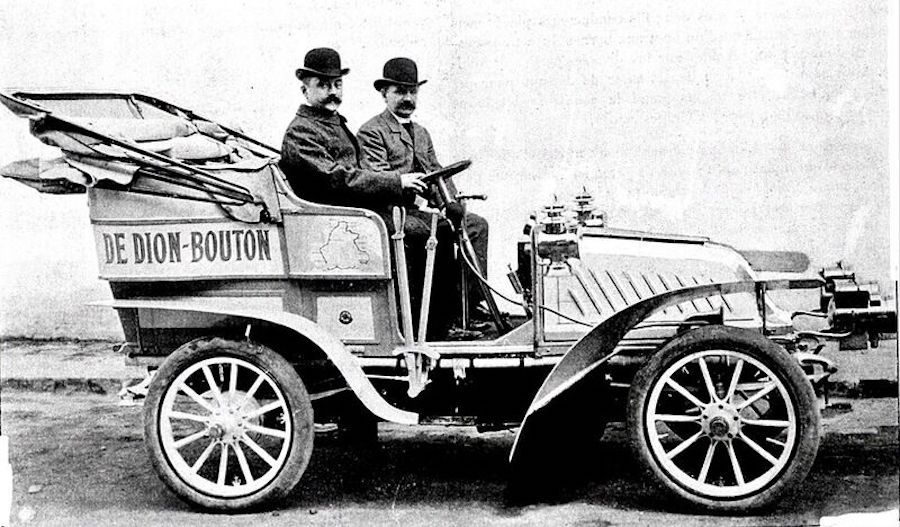
Right-hand drive was then regarded as more refined and technically superior, particularly on sporting cars. It should also be remembered that, at the time, the handbrake was mounted outside the vehicle. It had to be operated by pulling a lever, and the right hand – being the stronger hand for most drivers – was naturally preferred, providing a firmer and more secure grip.
THE AMERICAN REVOLUTION
In the United States, around 1750, a new type of four-wheeled covered wagon appeared, used to transport both passengers and goods. Known as the “Conestoga“ wagon, it required the driver to sit astride the left-hand horse of the pair closest to the wagon itself. From this position, the driver could handle the whip and control the team more effectively while also judging the often difficult passing manoeuvres with oncoming wagons approaching from the left.
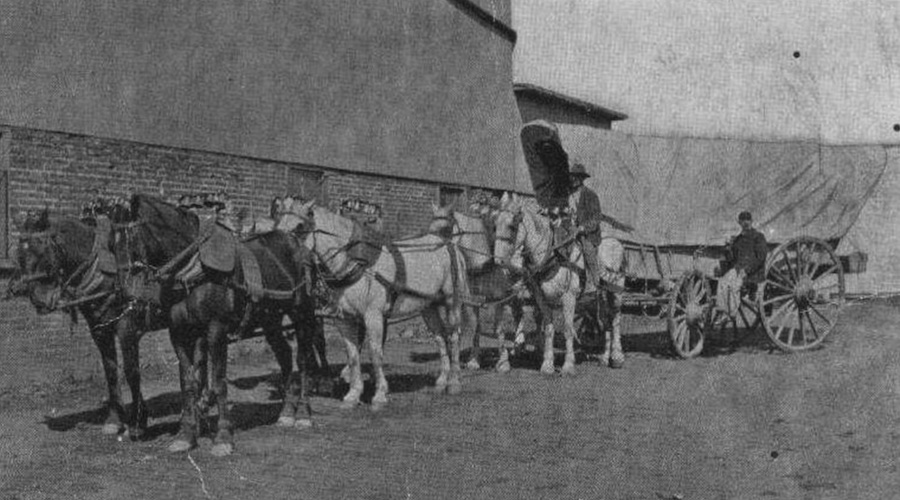
The Conestoga quickly became popular along the American East Coast and later spread to many European countries. As a result, right-hand traffic combined with a left-hand driving position gradually became widespread, and Pennsylvania became the first state to formalise this arrangement in 1792.
In 1908, Henry Ford introduced the Ford Model T, the first motor car to be produced on a truly large scale. Ford chose to position the steering wheel on the left for several reasons:
• the driver could step directly onto the pavement;
• overtaking was easier to judge, as the driver sat nearest the centre line of the road;
• the controls became more ergonomic in increasingly busy traffic.
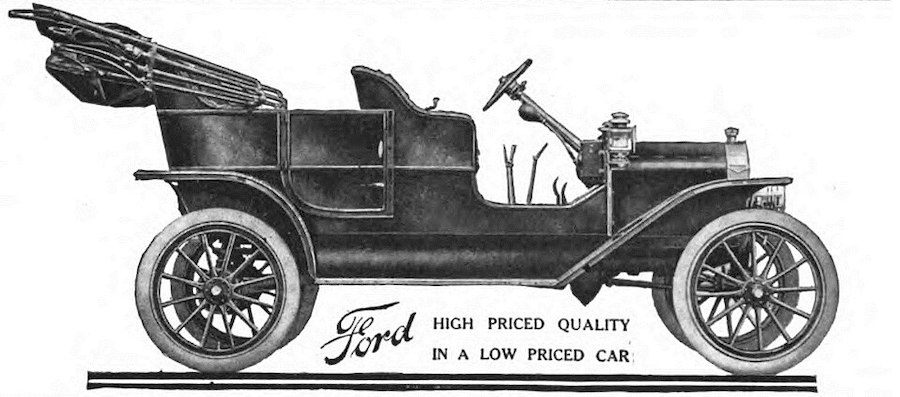
The phenomenal success of the Model T gradually influenced the global motor industry, as traffic volumes increased rapidly. Within a few years, almost all American manufacturers had permanently adopted left-hand drive, while Europe progressively followed suit during the 1920s and 1930s.
There is no evidence that driving on the left is inherently safer than driving on the right, or vice versa. Both systems are equally effective when implemented consistently.
The direction of traffic in any given country is, above all, the result of its history, its military heritage, its equestrian traditions and, later, its political and industrial choices. That is why this diversity still exists today. The road itself remains exactly the same. Only the side on which we drive – and the driver’s seat – changes.
As an amusing footnote to the story, there is one street in the very heart of London where traffic keeps to the right. It is Savoy Court, the private road leading to the legendary Savoy Hotel, where the victory of Dudley Benjafield and Sammy Davis in the 1927 24 Hours of Le Mans was celebrated following their triumph at the wheel of a Bentley 3 Litre.
For well over a century, first horse-drawn carriages and later motor vehicles have entered Savoy Court from the Strand by keeping to the right.
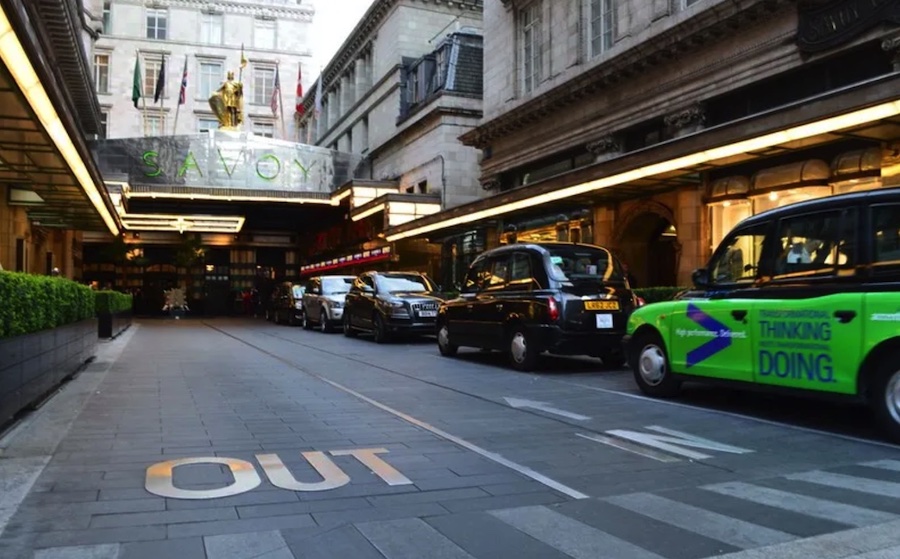
This unusual arrangement was even confirmed by a special Act of Parliament in 1902. It authorised the practice so that horse-drawn cabs, and later taxis, could set down their distinguished passengers on the correct side directly outside their favourite establishment. Drivers therefore had no need to leave their seat to open the door, while passengers could alight without having to walk around the vehicle, ladies traditionally being seated behind the driver.