
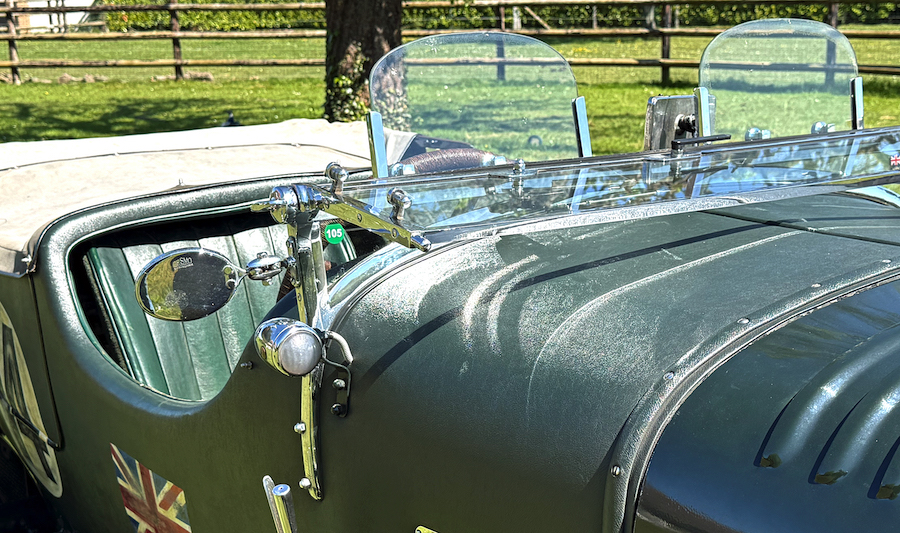
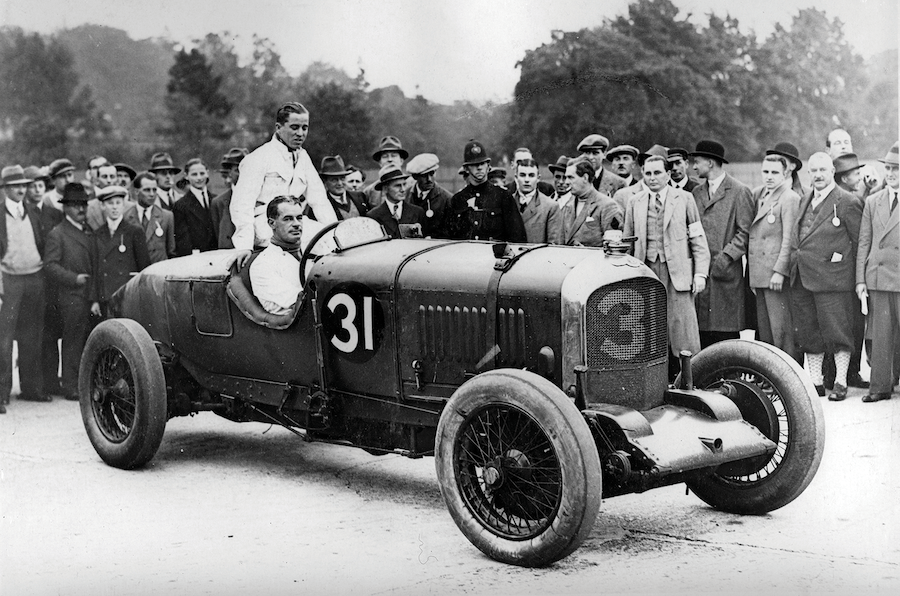
There are few details more evocative of a Vintage Bentley than a pair of small aeroscreens standing proudly above the scuttle. Framed in polished alloy, adjusted by a substantial wing nut, and angled towards the driver, it is almost inseparable today from the image of the Bentley driven hard at Brooklands or at Le Mans in the 1920s and 1930s.
Commonly called “Brooklands aeroscreens”, the name is particularly appropriate in the Bentley context. Brooklands was the proving ground on which Bentley established much of its early sporting reputation, and the circuit’s extraordinary speeds created precisely the conditions in which a small adjustable wind-deflector made sense.
The “Brooklands aeroscreen” was not simply invented at Brooklands, nor was it a Bentley invention. It appears to derive from a combination of its early association with aviation and its subsequent links with motorsport and the Brooklands circuit. The aeroscreen was subsequently manufactured and marketed by specialists such as V. W. Derrington and Frank Ashby & Sons.
Brooklands and the birth of high-speed motor racing
The Brooklands Motor Course, built in 1907, was the world’s first purpose-built motor racing circuit. It predated other equally famous international circuits, such as the Indianapolis Motor Speedway (1909), Monza (1922), Le Mans (1923) and Montlhery (1924). Brooklands quickly became a centre for high-speed competition, record attempts and technical experimentation. Its steeply banked concrete circuit permitted speeds that were exceptional for the period, making the question of how to protect the driver from the airflow increasingly important.
The racing cars of the early twentieth century were remarkably exposed machines. There was generally no enclosed cockpit and often little more than a rudimentary screen between the driver and the surrounding air. Goggles and protective clothing dealt with some of the problem, but at sustained high speed the airflow itself became a significant physical force.
A conventional upright windscreen could deflect the air, but it also created significant aerodynamic drag, additional frontal area and aerodynamic disturbance. For racing and sporting cars, where weight, visibility and aerodynamic efficiency were important, a smaller solution was attractive.
The aeroscreen provided that solution.
The principle of the aeroscreen
The First World War accelerated developments in both aerodynamics and lightweight engineering.
Open-cockpit aircraft required pilots to deal with intense airflow and propeller slipstream effect: adjustable transparent wind deflectors became familiar pieces of aviation equipment.
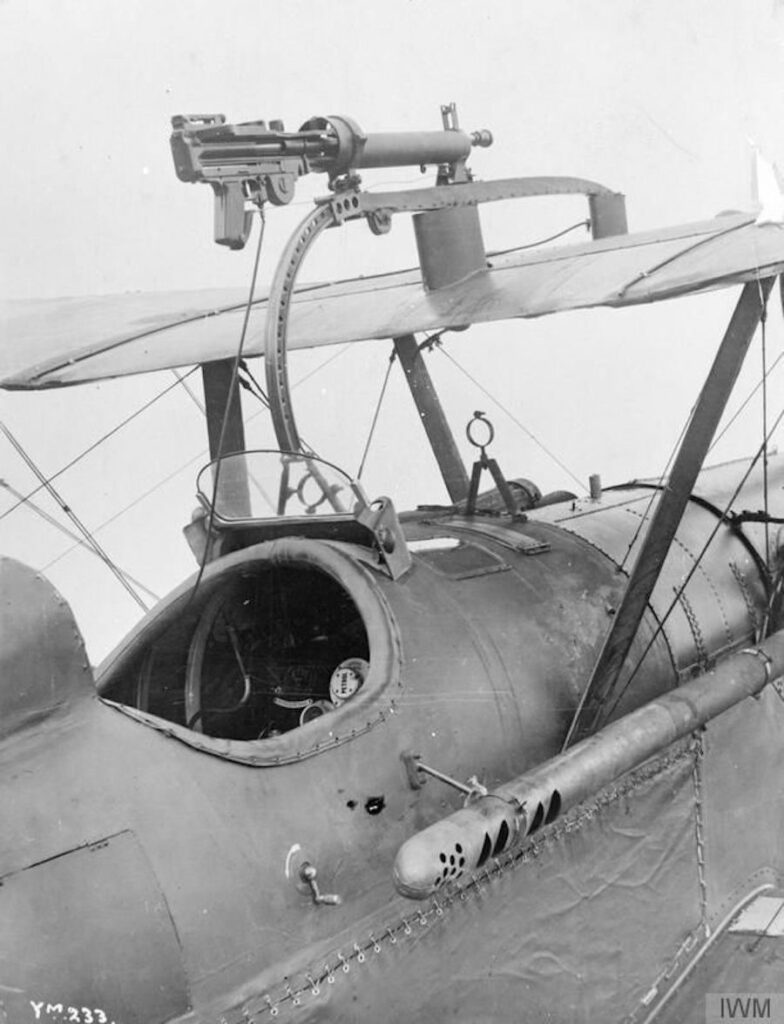
After 1918, a generation of engineers, mechanics and drivers emerged with experience of aircraft, aero engines and high-speed machinery. The young W.O. Bentley was one of them and his experience in the aviation (and railway) industries enabled him to adapt and improve upon concepts that had already been proven.
Brooklands itself was simultaneously a motor-racing circuit and an important centre of aviation activity. This created an unusually fertile environment for the exchange of ideas between aviation and motor racing: adjustable aerodynamic wind deflectors were part of the technical culture of the period.
An aeroscreen was not intended to provide the comprehensive protection associated with a more conventional windscreen. Its purpose was much simpler: to deflect the airflow away from the driver’s face and upper body while presenting as little obstruction as possible to make high-speed driving tolerable.
A typical installation consisted of two separate small panels, allowing the driver and riding mecchanic / passenger to have individual protection and permitting the screens to be adjusted independently. Single aeroscreens were also used, particularly on racing and single-seater machinery.
The resulting appearance was distinctive and its success lay precisely in its simplicity: a small glass panel held within a narrow metal frame, mounted directly to the scuttle ahead of the occupant(s). With the main windscreen removed or folded down, the car presented considerably less frontal area to the airflow.
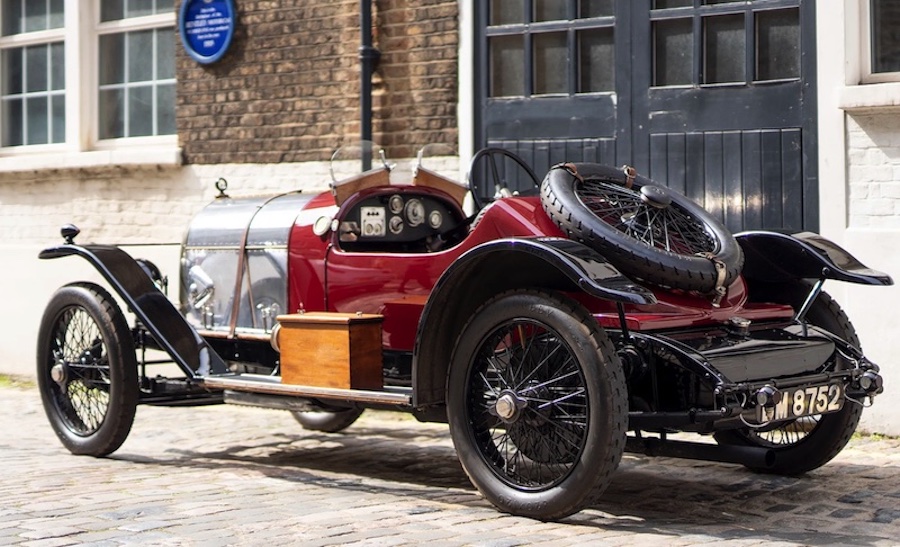
The technical principles behind the Brooklands aeroscreen remain surprisingly easy to understand, nearly 100 years later. It was:
- small, to minimise frontal area and reduce drag;
- angled, to redirect the airflow and to avoid cockpit turbulence;
- adjustable, to accommodate speed and driver position;
- light, to minimise unnecessary mass;
- rigid, to resist aerodynamic loading;
- and open, to preserve visibility and the character of the sporting car.
The Derrington and Ashby & Sons era
The Brooklands aeroscreen was subsequently developed and commercialised within the specialist British sporting-equipment trade, with firms such as V. W. Derrington with a wide range of racing accessories and Frank Ashby & Sons Ltd. that became particularly associated with its “Brooklands” range and marketed a specific “Brooklands Flarescreen” by 1930.
Victor William Derrington began his business career in 1919, initially with motorcycles, and became involved in racing and tuning at Brooklands. A later Motor Sport history of the company explains that he was a Brooklands competitor, entrant, tuner and supplier whose business developed in direct response to the need of Brooklands competitors.
In 1924, Derrington improved the original design of the aeroscreen using a friction assembly consisting of aluminium and fibre discs. A wing nut allowed the resistance to be preset, while a lock nut secured the adjustment. Once set, the wing nut could be used to alter the screen angle while the car was moving. The frame and lugs were polished aluminium, with brass bushes on the bearing surfaces to prevent binding. The design wasn’t simply a piece of flat glass mounted on a car: the mounting and adjustment mechanism were part of the engineering concept.
The design subsequently entered wider commercial circulation, notably through Frank Ashby & Sons, which in the thirties marketed the “Brooklands Flarescreen”, a related but distinct product. The Flarescreen was a removable screen mounted in two sockets attached to the scuttle, with a Bexoid screen (described as non-inflammable and non-discolouring) and chromium-plated frame. Derrington continued to manufacture and supply the screens for decades. Remarkably, the basic Derrington design remained available into the 1970s, using chromium-plated brass fittings, a polished die-cast alloy frame and laminated safety glass.
Nowadays, high-quality Brooklands aeroscreens can be found at Vintage and Classic Spares in the UK. The aluminium frames are die-cast, and then hand polished before assembly begins. A flat neoprene rubber seal is stretched around the edge of the laminated safety.
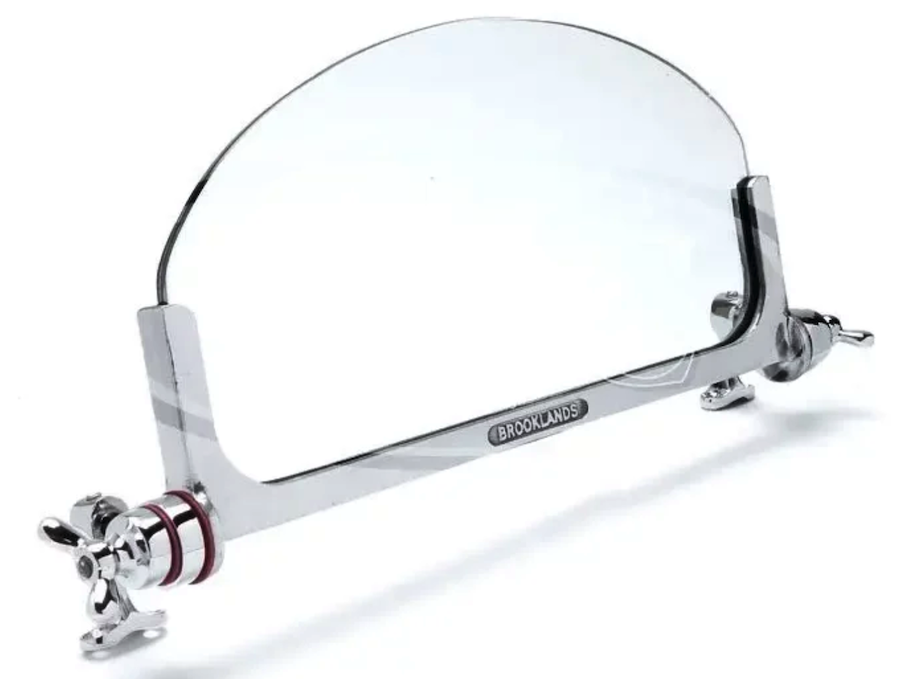
After trimming the rubber shrinks back slightly to give a neat and secure fit. The end fittings are brass made with the lost-wax casting process and then chrome plated. Ultimately, the Brooklands aeroscreen is far more than a distinctive styling feature. It captures the spirit of an era when driving was about direct sensations, mechanical simplicity and an unmistakable connection between driver and driving experience.
By combining period character with a functional purpose, the aeroscreen gives the Brooklands a unique identity – one that feels both evocative and genuinely purposeful. It may belong to another age, but that is precisely its appeal: in a world increasingly defined by comfort and technology, the Brooklands aeroscreen brings back the raw, exhilarating essence of motoring.