A LONG HISTORY
Since its invention 5,500 years ago, the wheel has come a long way. One of mankind’s greatest inventions has lost none of its usefulness and has become even more efficient, especially when that same wheel was combined with the pneumatic tyre in 1845!
The pneumatic tyre has continued to evolve for nearly two centuries. We have had to learn how to master rubber, contain air, incorporate textiles and steel, and develop a multitude of rubber compounds, while never losing sight of one fundamental engineering challenge that remains relevant today: allowing the tyre to flex thousands of times a minute without overheating, wearing prematurely or coming apart.
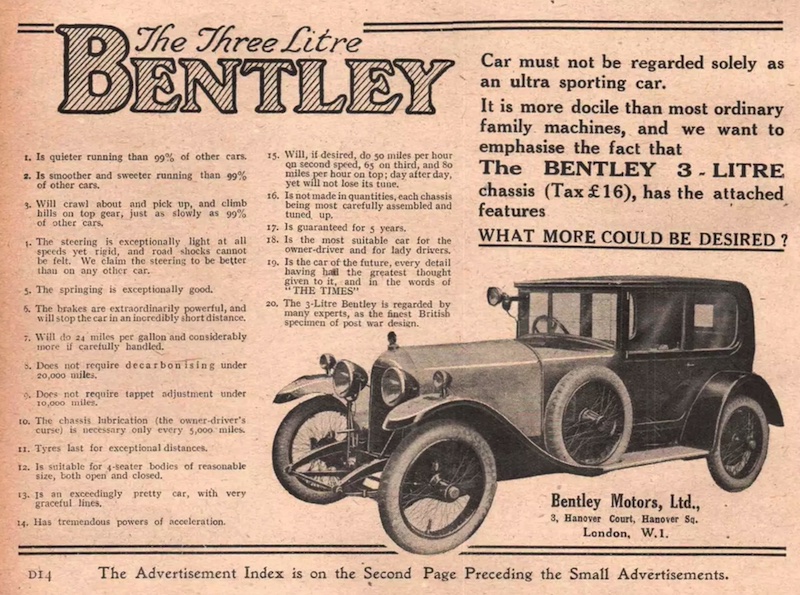
The history of the Cricklewood Bentleys (1922 to 1932) spanned a particularly fascinating period of transition. It began with the tall, narrow beaded-edge tyres (or clincher tyres) of the early 1920s, initially fitted to the first so-called “Experimental” Bentleys and subsequently to the new 3 Litre model. There followed the era of straight-sided tyres with wire beads (straight-sided or wired-on tyres), which were subsequently used on both the 3 Litre and 4½ Litre models.
The wider cross-ply tyres, fitted to smaller-diameter rims, together with the so-called “balloon” tyres – wider still and designed to operate at lower pressures – became later associated with the 6½ Litre, 4½ Litre, Speed Six and later 8 Litre models.
Tyre technology evolved dramatically, progressing from a relatively fragile component to which the motor car largely had to adapt, to a genuine piece of engineering whose characteristics directly influenced the design and performance of the automobile. And competition was central to that development.
KEY TYRE DATES
1839 – Charles Goodyear discovers vulcanisation
American inventor and chemist Charles Goodyear accidentally discovers vulcanisation after spilling a mixture of rubber (produced naturally from a tree known as the rubber tree, or hevea, or manufactured artificially through a chemical process), sulphur and other substances onto a heated plate. The process transforms the mixture into a hardened, more durable material.

Goodyear’s story, however, is far from that of an inventor who became a wealthy industrialist. Charles Goodyear died in 1860 in difficult financial circumstances.
And despite the name, he had no family connection with the Goodyear Tire & Rubber Company, founded in 1898 by brothers Frank and Charles Seiberling in Akron, Ohio (USA). The Seiberlings chose the name “Goodyear” as a tribute to the inventor and his discovery.
The vulcanisation process represents the first major building block in the history of the tyre.
1845 – Robert William Thomson invents the “Aerial Wheel”
Scottish inventor Robert William Thomson patents the “Aerial Wheel”, the first pneumatic tyre, consisting of a hollow rubber belt inflated with air, so that the wheels form an air cushion against the ground, rails or road surface on which they travel.
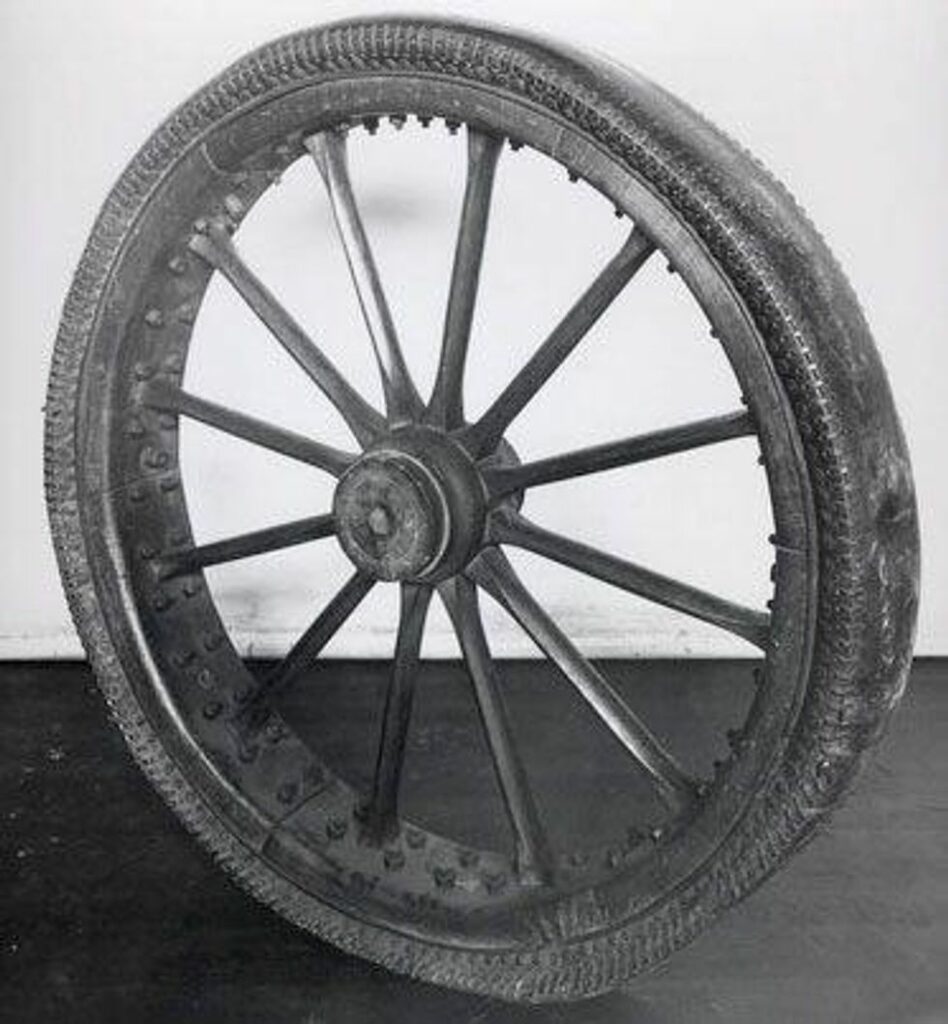
This elastic, rubberised fabric tube is enclosed within a strong outer leather casing bolted to the wheel. Unfortunately, the manufacturing cost was extremely high and the design was too complex to reproduce economically, so the invention was effectively shelved for more than 40 years.
1888 – John Boyd Dunlop and the tyre that transformed cycling
In 1888, Scottish-born Belfast veterinary surgeon John Boyd Dunlop developed a pneumatic tyre, initially for the tricycle ridden by his young son. His design consisted of an air-filled rubber tube fitted around the wheel and inflated under pressure, dramatically improving comfort and reducing rolling resistance compared with the solid tyres then commonly used.
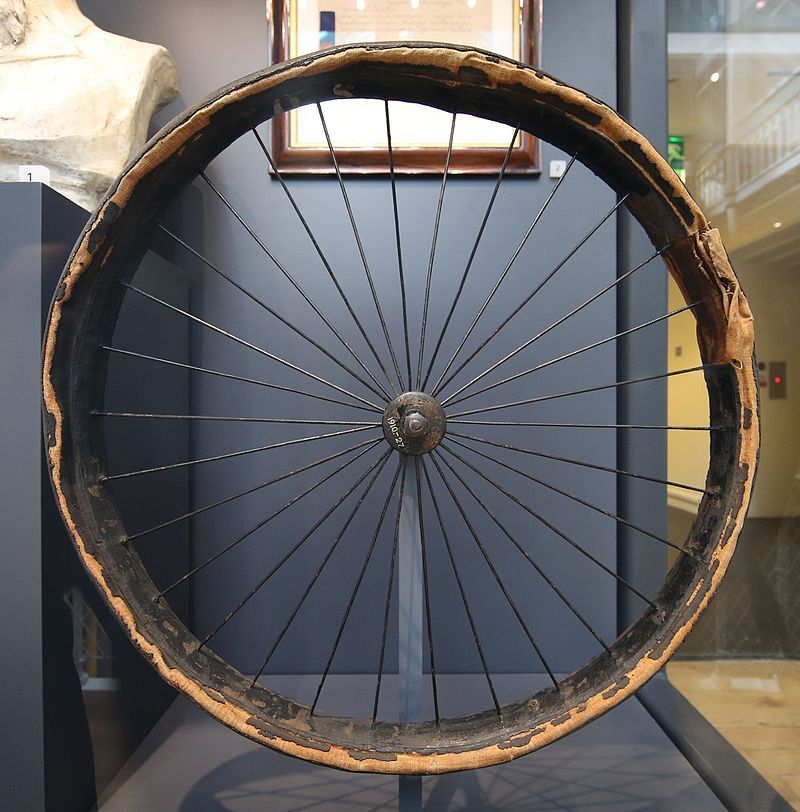
Dunlop obtained a patent for his pneumatic tyre in 1888, although he was not, strictly speaking, the original inventor of the concept. Scottish engineer Robert William Thomson had patented a pneumatic tyre as early as 1845, and Dunlop’s patent was subsequently declared invalid on the grounds of Thomson’s earlier invention.
Nevertheless, it was Dunlop who successfully transformed the pneumatic tyre into a practical and commercially important product. Its advantages became particularly apparent in cycle racing. In May 1889, racing cyclist Willie Hume famously used Dunlop pneumatic tyres in Belfast, winning four of the five races in which he competed. Other racing cyclists soon adopted the new technology, helping to establish the pneumatic tyre’s reputation for speed and performance.
There was, however, an important drawback: Dunlop’s early tyres were fixed to the wheel and were consequently difficult to remove and repair in the event of a puncture.
But the pneumatic tyre had already found its first great proving ground: competition.
1890 – Parallel innovations
The development of the pneumatic tyre at the end of the nineteenth century involved several parallel innovations.
William Erskine Bartlett developed the “beaded-edge tyre” (also known as the clincher principle), in which shaped tyre beads engaged with hooked edges on the rim, while Charles Kingston Welch patented the competing “wired-on” principle in 1890.
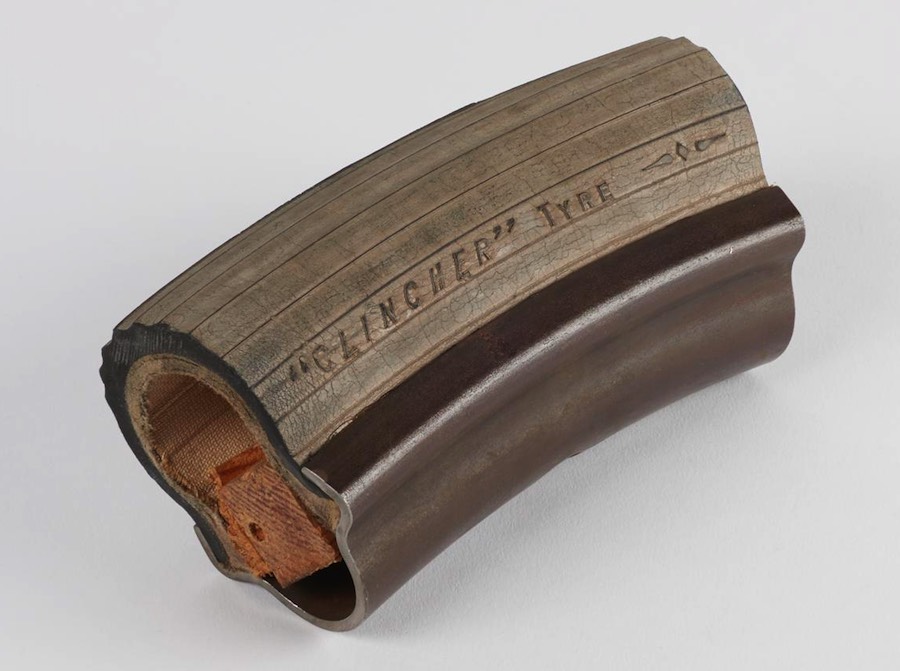
A further major advance came in 1891, when the French brothers Edouard and André Michelin developed their practical detachable pneumatic tyre for bicycles, allowing the tyre to be removed from the wheel for comparatively rapid repair.
The principle may seem obvious today. At the time, however, it was revolutionary: repairing a pneumatic tyre was a lengthy and laborious process.
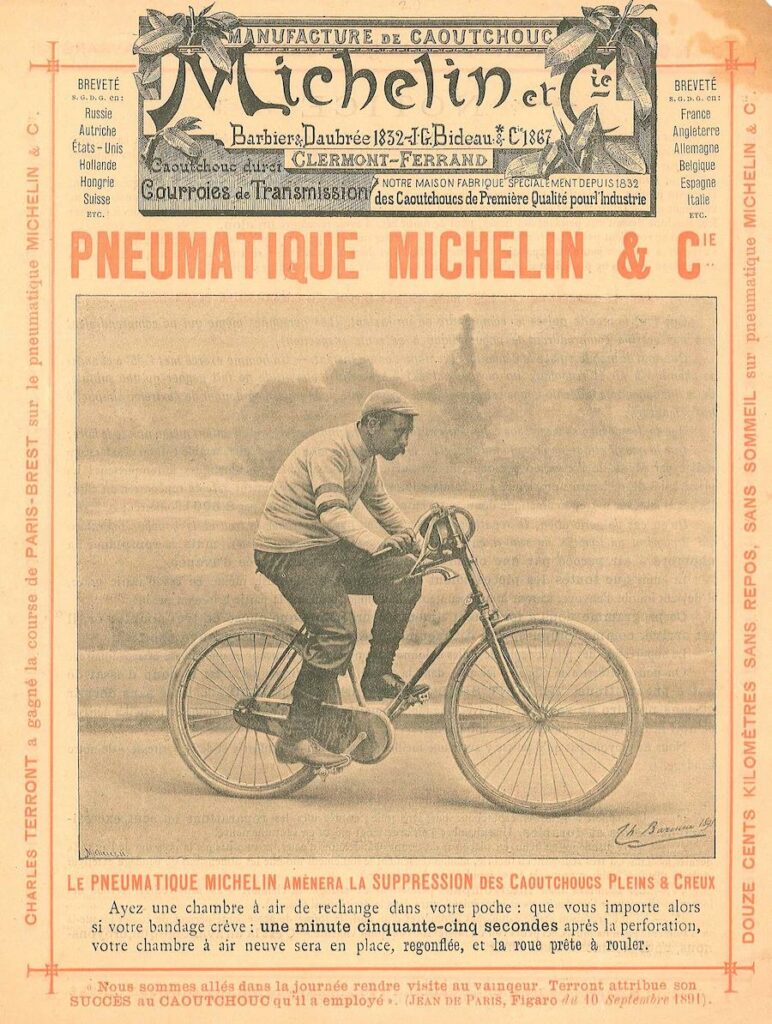
The Michelin brothers‘ innovation dramatically simplified puncture repairs. Its effectiveness was spectacularly demonstrated by Charles Terront, who used Michelin detachable pneumatic tyres during the Paris–Brest–Paris race in 1891.
In 1895, the Michelin brothers modified a Peugeot chassis and equipped it with a Daimler boat engine. They fitted their prototype, known as L’Éclair, with four detachable pneumatic tyres fitted with valves. The car took part in the 1,200-kilometre Paris–Bordeaux–Paris race that same year.
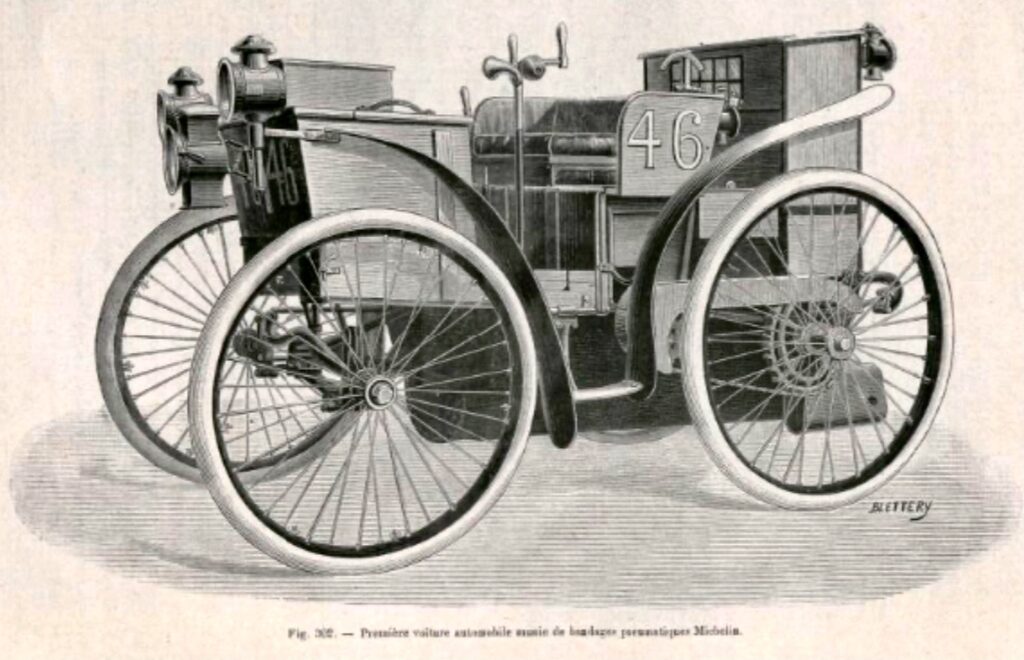
Despite suffering more than 50 punctures, most of which could reportedly be repaired in less than 15 minutes, Michelin had demonstrated something essential: pneumatic tyres could withstand the demands of motoring.
At the end of the nineteenth century, reaching 100 km/h was almost the stuff of science fiction.
On 29 April 1899, at Achères, near Paris, the Belgian driver Camille Jenatzy took the wheel of La Jamais Contente, a remarkable electric car shaped rather like a projectile. He became the first person to break the symbolic 100 km/h (62 mph) barrier, reaching 105.88 km/h (65.25 mph).
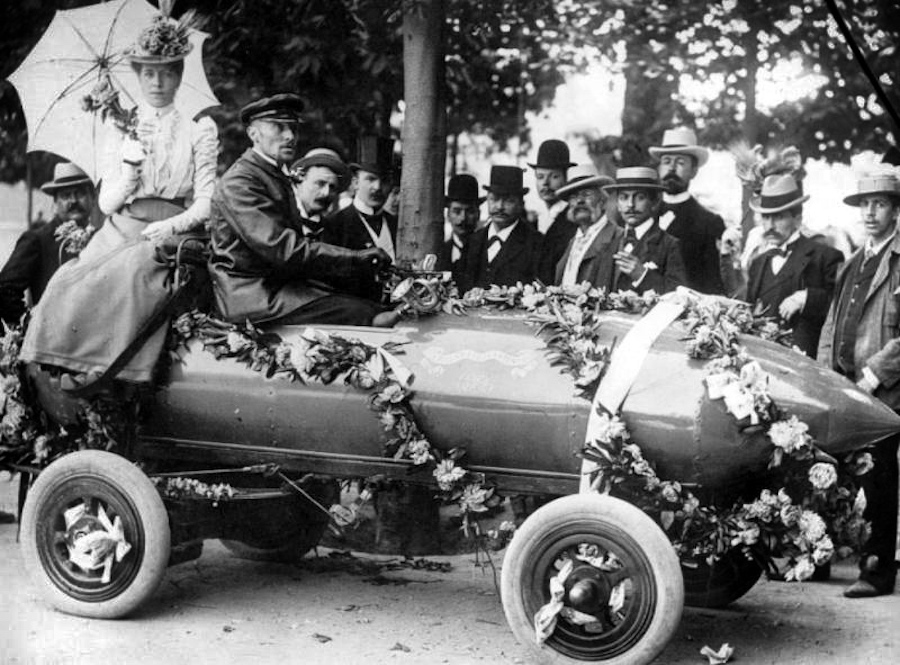
The record demonstrated that the tyre was becoming a performance component in its own right. As motor cars became faster, tyres had to withstand ever-increasing loads, temperatures and cornering forces.
The tyre was no longer merely an accessory: it had become an integral part of the motor car’s performance.
The Early 1900s – Goodyear and Firestone at the Forefront
The history of rubber in North America began in Akron, Ohio, long before the tyre revolution. In 1870, Dr Benjamin Franklin Goodrich established the region’s first rubber factory there.
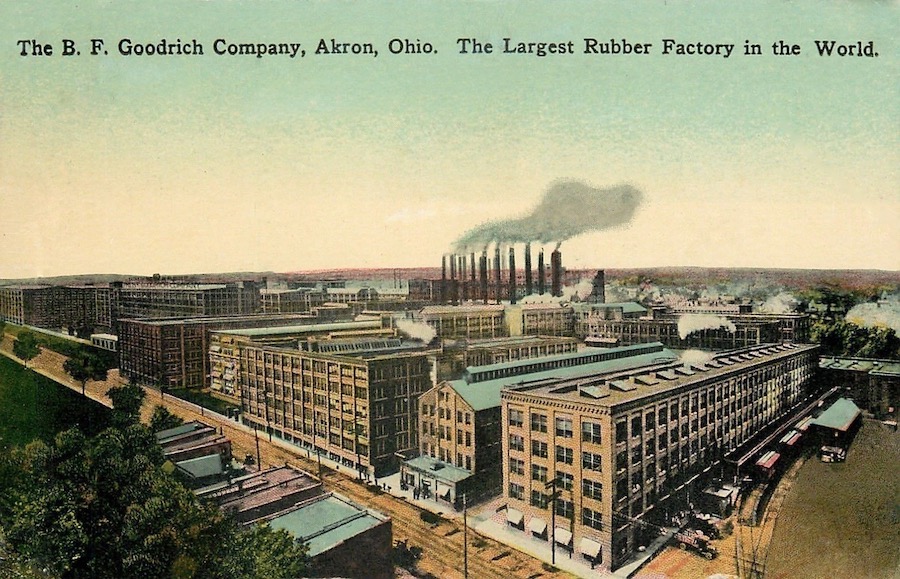
Attracted by the financial backing of local entrepreneurs and the abundant supply of water, Goodrich helped make Akron the birthplace of the industry. In 1898, Franck and Charles Seiberling brothers founded the Goodyear Tire & Rubber Company (this American company has no connection with Charles Goodyear or his family).
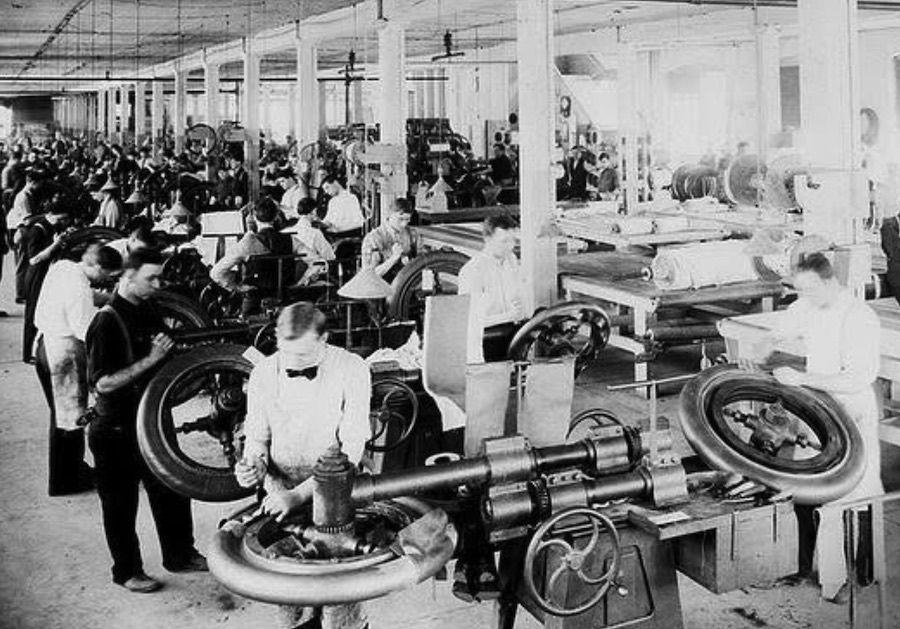
Harvey Firestone founded Firestone in 1900, before securing later an exclusive contract with Henry Ford to supply tyres for the iconic Ford Model T.
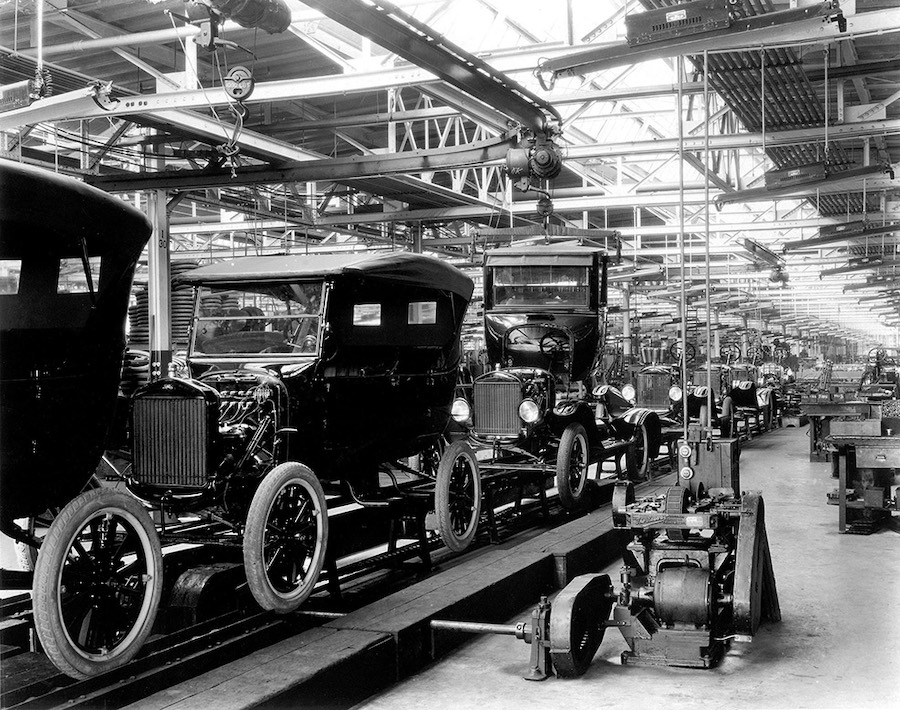
With direct access to Ford denied to them, the Seiberling brothers put all their efforts into the replacement market and technical innovation, seeking to win over the other emerging motor manufacturers, such as General Motors.
In 1901, Goodyear introduces a straight-sided tyre featuring a braided metal wire in the bead. This design helps keep the tyre securely seated on the rim while making removal easier for maintenance. It also improves ride comfort. It may seem like a small development, but it already illustrates a fundamental rule of tyre engineering: every detail of the construction matters.
1910 – The tyre becomes more rigid
Research carried out by the various tyre manufacturers leads to a number of technological developments. A metal bead wire is incorporated into the tyre bead to improve the wheel’s rigidity and ensure better retention on the rim.
Carbon black is also added to the rubber compound during manufacture, improving the tyre’s resistance to wear and mechanical stress. The tyre is beginning to evolve into a genuinely sophisticated industrial product.
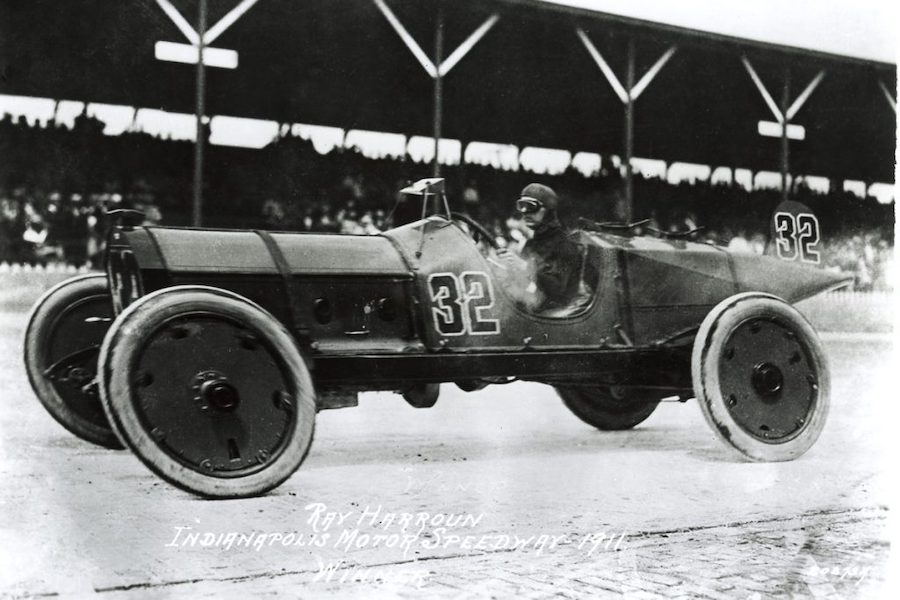
Firestone made Indianapolis in the USA its own territory. From the very first race in 1911, won by a car fitted with Firestone tyres, the brand would dominate American racing for decades.
1920s and 1930s – Major technological innovations
Motor cars were becoming faster, heavier and more powerful, and tyre engineers were discovering that the way a tyre was attached to the rim, the construction of its carcass, its dimensions and its inflation pressure were just as important as the rubber compound itself.
The evolution of the Vintage Bentley cars provides a particularly good illustration of this transformation. Between the first 3 Litre Bentleys of the early 1920s and the final Cricklewood cars of 1931–32, tyre technology evolved from the tall, narrow “beaded-edge” tyre, through the adoption of the “straight-sided” or (“wired-on”) tyre, to increasingly sophisticated “cross-ply” (known as “bias-ply” in the American terminology) carcasses and the larger-section, lower-pressure tyres generally associated with the “balloon-tyre” principle.
These terms should not, however, be regarded as four completely separate or strictly successive types of tyre. They describe different aspects of tyre technology.
A “beaded-edge” tyre describes principally the method by which the tyre is retained on its specially shaped rim. A “straight-sided” (or “wired-on”) tyre uses an inextensible wire incorporated into each bead to secure the tyre to the rim. “Cross-ply” (or “bias-ply”) describes the internal construction of the carcass, with successive layers of reinforcing cords running diagonally from bead to bead in opposing directions. Balloon, meanwhile, describes the development towards a tyre of substantially larger cross-section and air volume, capable of carrying its load at a lower inflation pressure.
Consequently, a late-1920s tyre could simultaneously be described as wired-on, cross-ply and balloon-type without any contradiction.
- The early Bentley: the beaded-edge era
When the Bentley 3 Litre entered production in 1921, the motor industry was still firmly rooted in the technology inherited from the previous decade: the dominant tyre design used for motorcycles and cars in Europe – and still common in America – was the beaded-edge tyre, also called a clincher tyre in the USA, (“pneu talon” in French).
It was a remarkably simple solution. These had a fabric carcass with no metal reinforcement in the bead; instead, thick rubber ridges running around the tyre’s inner circumference hooked into a matching lip (clinch) on the special wheel rim.
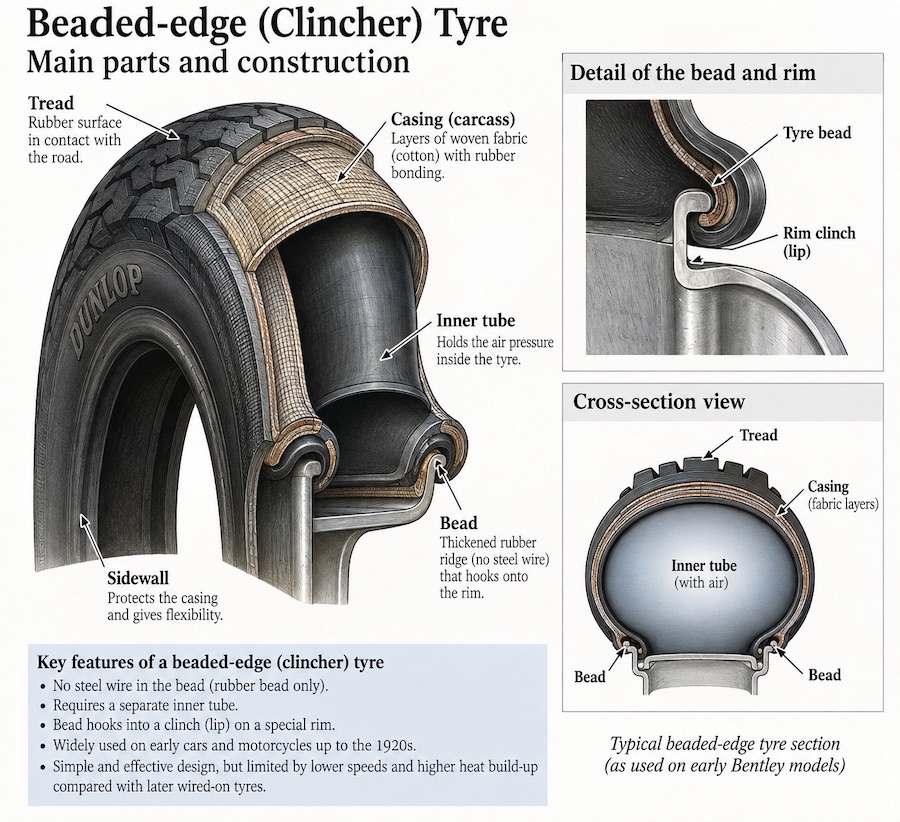
These tyres required a specialized inner tube to hold air, as the tyre itself couldn’t seal against the rim independently. A minimum pressure of 60 psi (4 bars) was needed to force and hold the rubber bead outward into the hooked lip of the rim.
This design had real drawbacks. Mounting or removing the tyre could be a demanding operation. Because the tyre relied purely on air pressure pushing the bead into the rim’s clinch to stay seated, punctures often caused the tyre to blow off the wheel entirely, sometimes tearing the bead in the process.
Despite this, beaded-edge tyres persisted on many marques into the mid-1920s and beyond – Ford kept using them because they were cheaper, while manufacturers such as Sunbeam and Bentley preferred them because they kept the steering light. They were still being specified for sporting cars like early Bugattis well into the decade.
The early 3 Litre Bentley normally used 820×120 beaded-edge tyres (with an 880×120 option also used for colonial models needing extra ground clearance). This notation was quite different from modern tyre sizing. 820 represented approximately the overall inflated tyre diameter in millimetres, while 120 represented the nominal tyre section, again in millimetres. Thus the wheel and tyre combination was extremely tall and narrow by modern standards.
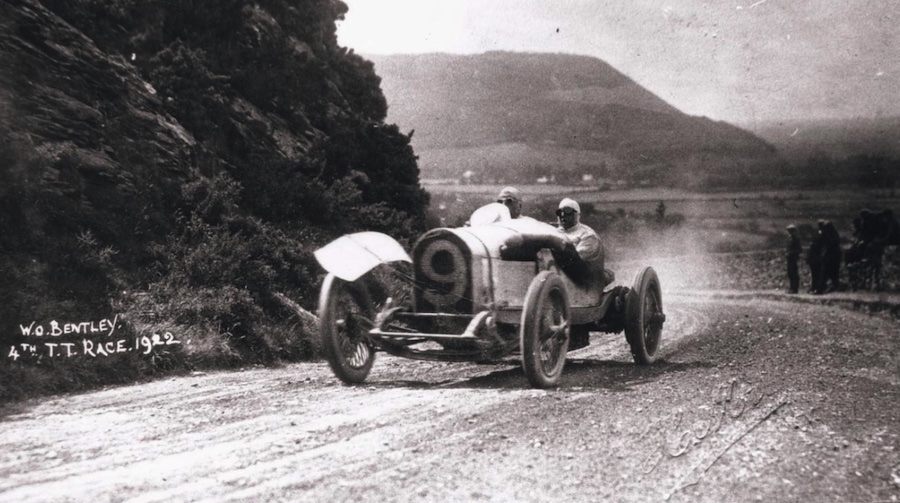
The 3 Litre quickly demonstrated that the apparently archaic-looking tyre and wheel combination was capable of serious competition: Bentley entered their first significant race on 22 June 1922 at the RAC Tourist Trophy on the Isle of Man. Frank Clement and his riding mechanic Wally Saunders (Bentley 3 litre, chassis TT42, registration ME1884) finished second, W.O. Bentley and Leslie Pennal finished fourth (Bentley 3 litre, chassis TT72, registration ME3115), while Douglas Hawkes and Bertie Browning (Bentley 3 litre, chassis TT74, registration ME3494) finished fifth. Bentley was the only team to get all its cars to the finish.
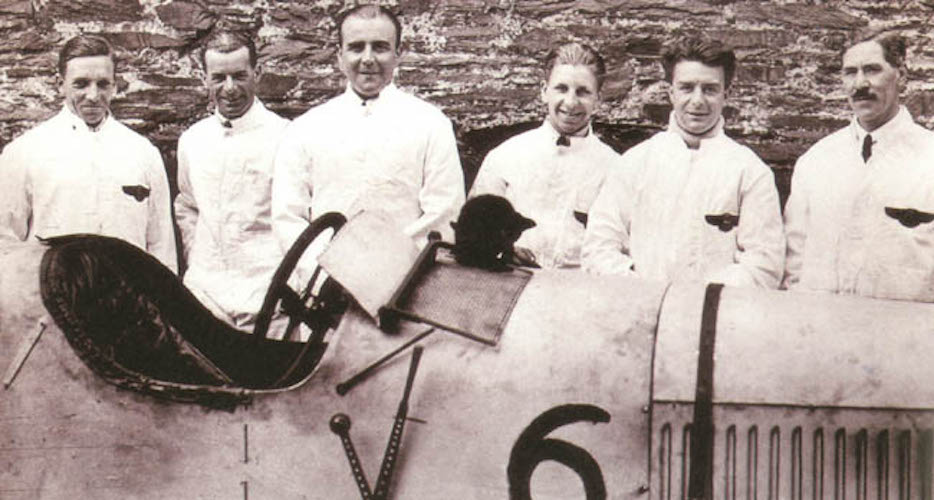
– 1923: For the inaugural 24 Hours of Le Mans in 1923 (known at the time as the “Rudge-Whitworth Cup”), John Duff entered his personal Bentley 3 Litre, (chassis 141, registration XM 6761) with Frank Clement as co-driver. The car ran on “Rapson tyres”.
This was not simply a commercial choice. Lionel Rapson was attempting to produce an exceptionally durable tyre, and endurance racing provided the perfect demonstration.
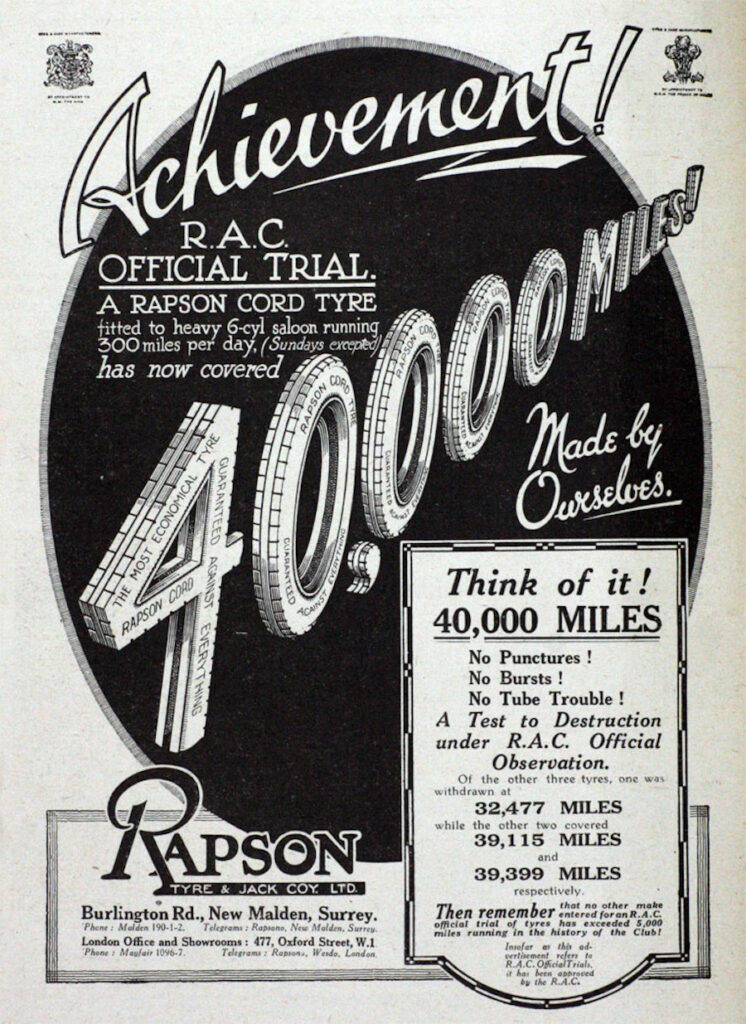
This Bentley was the only car in the entire 1923 Le Mans field to run on Rapson tyres – a remarkable distinction in a race otherwise dominated by Englebert, Michelin, and Dunlop.
Duff and Clement finished fourth overall, having also set the fastest lap of the race at an average speed of 107.33 km/h (66.69 mph). Even more remarkably, the Rapson tyres lasted the entire 24 hours without requiring a single change, despite covering more than 112 laps and approximately 1,933 km over the notoriously rough Le Mans roads. This remarkable performance fully vindicated Rapson’s philosophy of extreme durability and gave the Bentley the additional advantage of dispensing with the significant weight of a spare wheel.
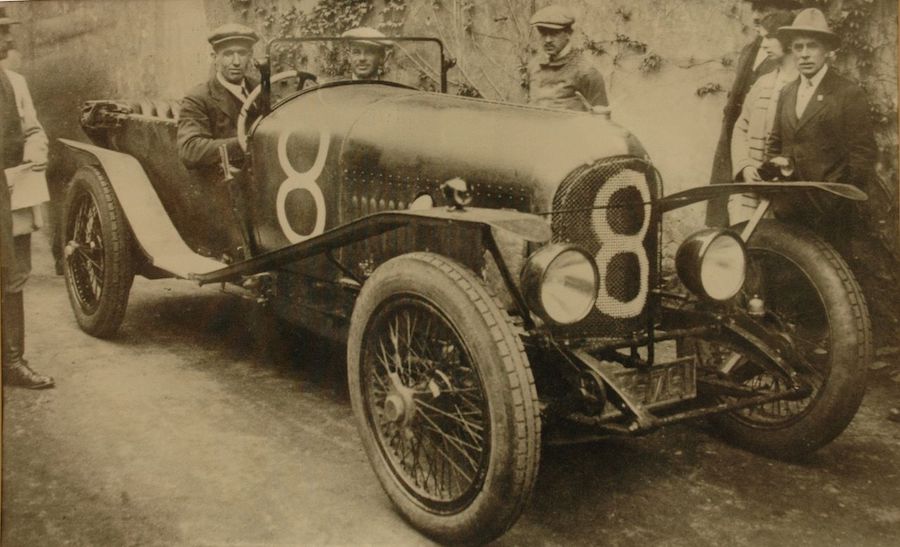
The tyre performance had therefore demonstrated something extremely valuable: a Bentley could race for 24 hours without routinely consuming tyres. That was strategically important at a time when changing a wheel cost vastly more time than it does in modern motor racing.
Rapson’s philosophy of endurance was perfectly aligned with W. O’s own engineering principles. Bentley built his manufacturer’s reputation on a combination of strength, displacement, reliability and the ability to sustain high speeds over long distances. Rapson approached tyre design with much the same philosophy: durability and consistent performance over prolonged use, rather than simply pursuing maximum short-term speed or grip.
– 1924: Bentley returned to Le Mans in 1924 with considerably greater factory involvement. John Duff and Frank Clement drove the famous No. 8 Bentley 3 Litre (chassis 582, registration XT 1606), once again fitted with Rapson tyres. The Bentley completed 120 laps, covering 2,077.34 km at an average speed of 86.55 km/h (53.78 mph) – and won the race outright!
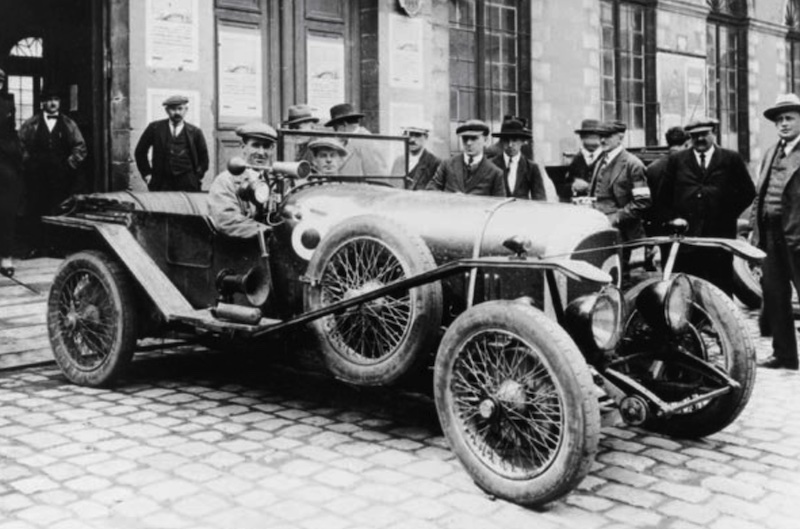
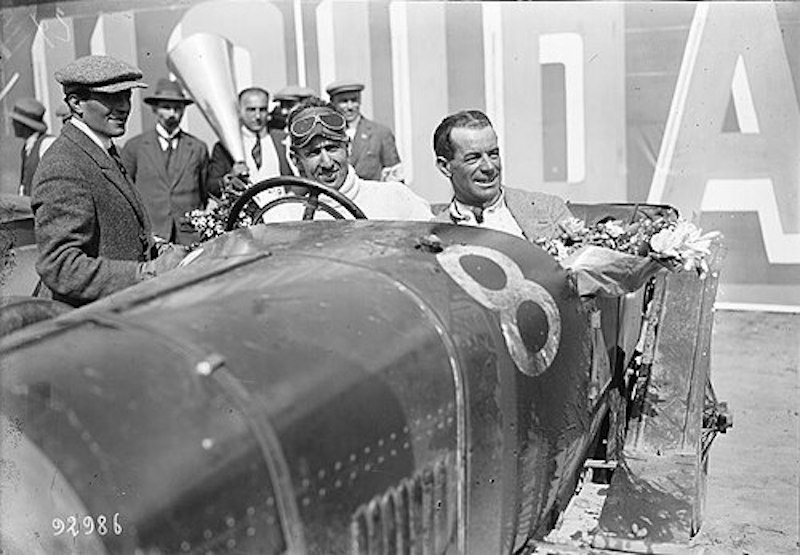
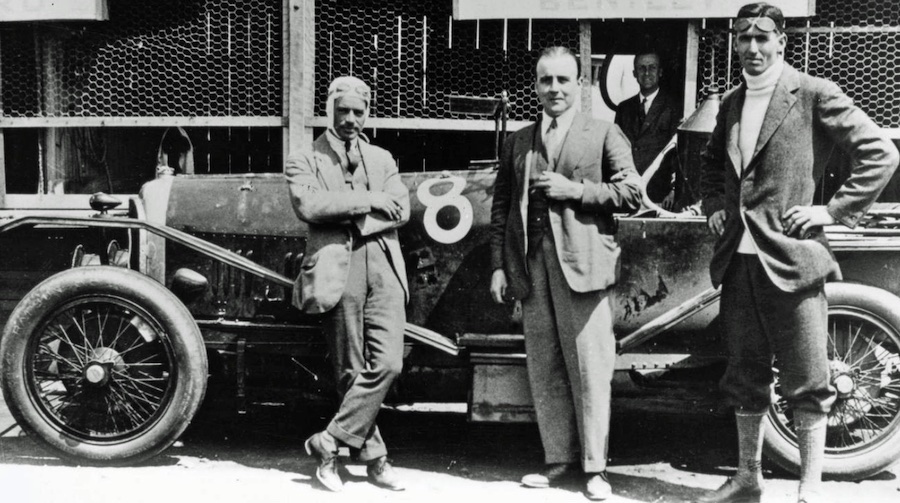
Rapson subsequently became particularly associated with long-distance racing tyres. Motor Sport magazine records that Rapson was supplying its “special double-treaded tyres” to Bentley, Sunbeam and Talbot racing teams during this period.
The Rapson relationship did not disappear after the 1924 victory.
– 1925: In 1925, Bentley returned to the 24 Hours of Le Mans with two 3 Litre cars, using Rapson tyres for the third consecutive year, this time of a special double-treaded design. The No. 9 Bentley (chassis 1040, registration MD 7187) was driven by John Duff and Frank Clement, while the No. 10 car (chassis 1138, registration MH 7580) was entrusted to Bertie Kensington-Moir and J.Dudley Benjafield.
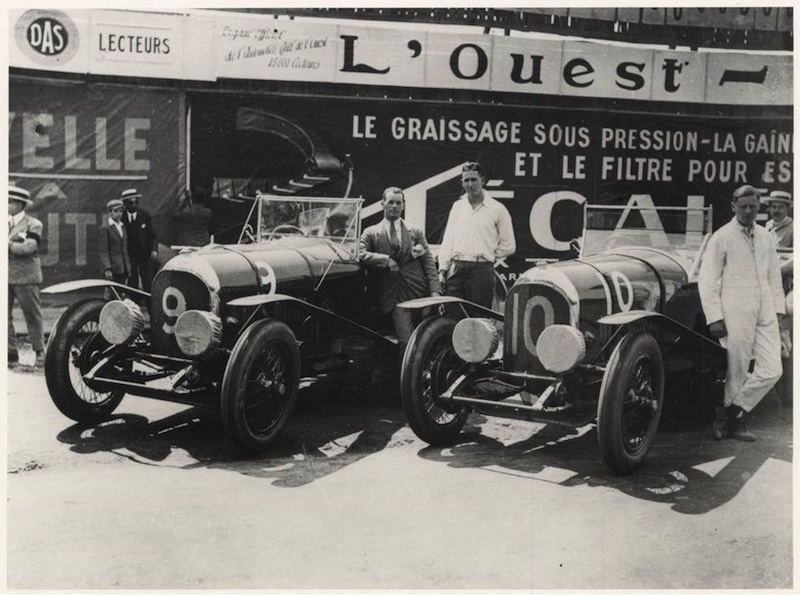
Neither Bentley finished the race, although in both cases the retirement was unrelated to tyre failure. Duff and Clement retired following carburettor and fire-related problems, while Kensington-Moir and Benjafield were forced out by fuel starvation.
- The transition to straight-sided (wired-on) tyres
During the middle years of the 1920s, Bentley progressively entered the era of the “straight-sided”(or “wired-on”) tyre.
The shift was driven partly by road conditions: from about 1924, alongside the move to rear-wheel-only brakes, manufacturers began abandoning beaded-edge tyres as tarmacadam roads spread, since the higher grip of tarmac (compared to loose surfaces) generated much greater side forces trying to pull the tyre off the rim.
Instead of relying upon the hooked-rim principle of the beaded-edge tyre, the newer system incorporated an inextensible wire into each tyre bead. The wired beads seated securely against the rim, and the development of the well-base or drop-centre wheel rim made the tyre both more securely retained and more practical to remove and refit.
This represented an important technological step for Bentley. Specialist tyre references identify the later 3 Litre fitment as 5.25 × 21 (5.25 inches = nominal tyre section width 21 inches = nominal rim diameter), replacing the earlier 820 × 120 (approximate overall diameter and section width in millimetres) beaded-edge arrangement. Although the two tyre sizes produced broadly similar overall rolling diameters, they belonged to fundamentally different wheel-and-tyre architectures and were not interchangeable on the same rims.
It represented far more than a change from metric to imperial notation.
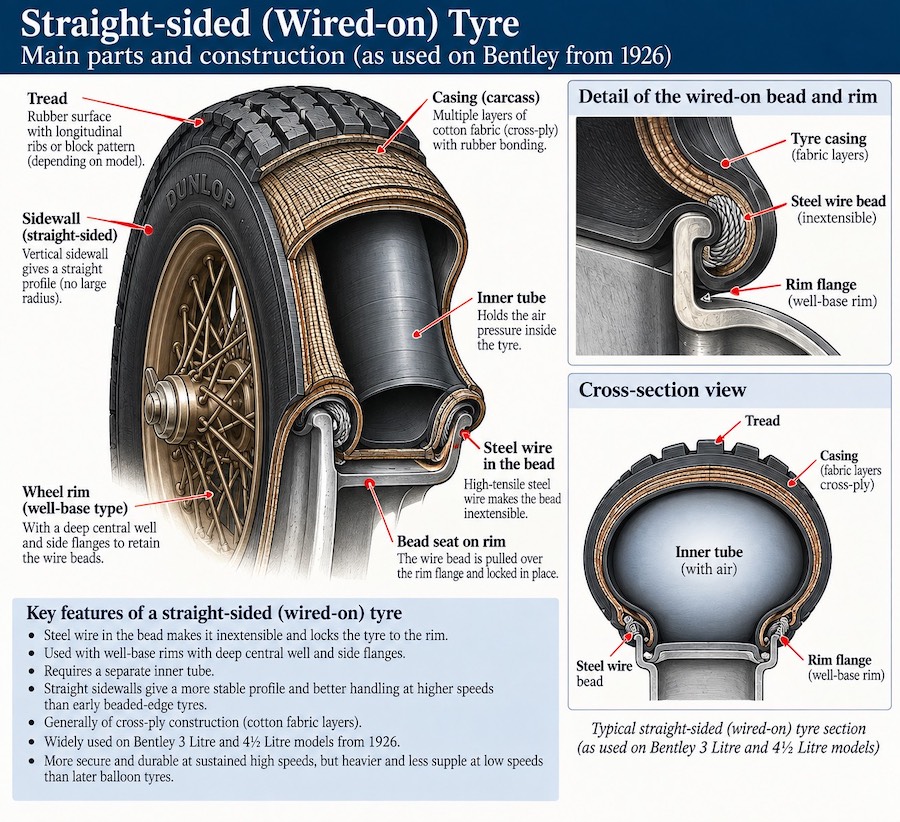
The transition should not be assigned too rigidly to a single year. Bentley chassis remained in service for long periods, owners changed wheels and tyres, competition cars evolved separately from road cars, and specifications could vary according to chassis, bodywork and market. It is therefore more historically accurate to describe a progressive transition during the 1920s rather than suggest that every Bentley changed tyre technology simultaneously.
Nevertheless, by the time Bentley introduced the 6½ Litre in 1926 and the 4½ Litre in 1927, the company’s cars were becoming larger, heavier and faster, making the more secure wired-on system increasingly appropriate. Bentley’s own history confirms this parallel growth in the size and performance of its cars: the 6½ Litre appeared in 1926 partly in response to customers fitting increasingly heavy coachwork to their 3 Litre chassis, followed by the 4½ Litre in 1927, the Speed Six in 1928 and the 8 Litre in 1930.
After 1925, Bentley’s works competition cars switched decisively to Dunlop tyres. Dunlop was actively developing the safer well-base rim because of the serious problem of beaded-edge tyres leaving their rims at racing speeds. This was a substantial safety improvement. It also allowed lower inflation pressures. Contemporary tyre history records Dunlop’s move toward straight-sided tyres on well-base rims during this period.
– 1926: Bentley’s 1926 Le Mans campaign ended with all three 3 Litres failing to finish: the first 3 Litre driven by Frank Clement and George Duller (chassis LM1345 – registration MK 5205) retired with valve trouble, the second car driven by Tommy “Scrap” Thistlethwayte and Clive Gallop (chassis 1179 – registration KM 4250) suffered a broken rocker arm, and the “Old Number Seven” driven by Sammy Davis and Dudley Benjafield (chassis LM1344 – registration MK 5206) suffered fading brakes and ended its race in the Mulsanne sandbank only about 20 minutes from the finish!
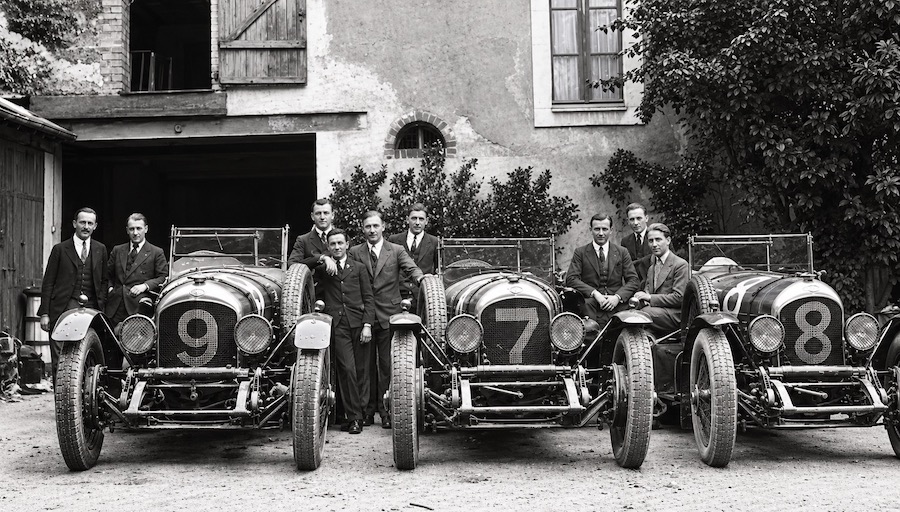
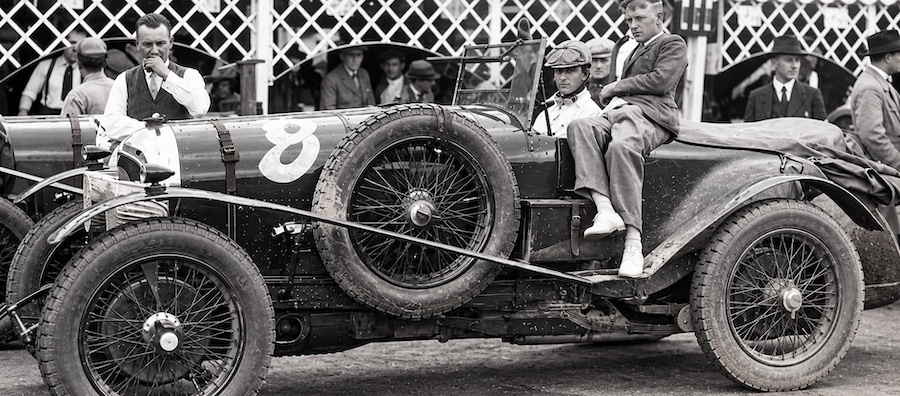
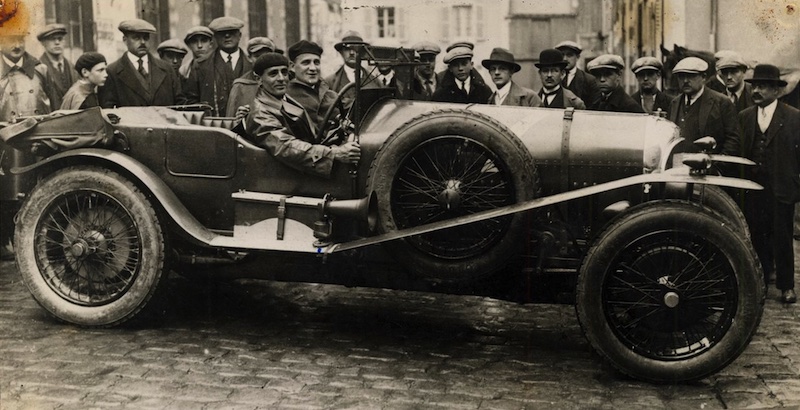
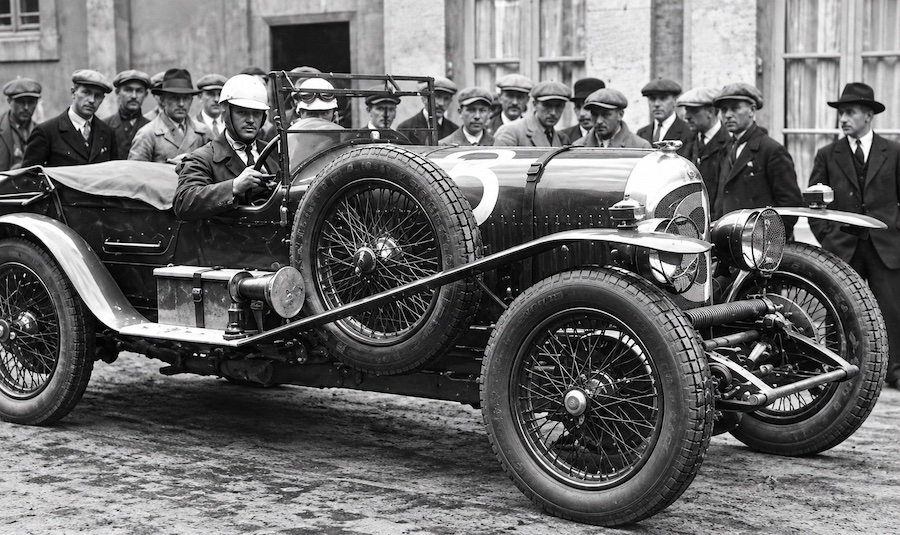
The Dunlop tyres had therefore survived a particularly severe Le Mans test – an encouraging result at the beginning of what would become an extraordinarily successful association between Bentley, Dunlop and the 24 Hours of Le Mans.
- Cross-ply: different part of the story
At the same time, another important development was taking place inside the tyre itself.
The cross-ply tyre, called a bias-ply tyre in the US, used several layers of rubberised textile cord laid diagonally across the carcass. Successive plies ran in opposing directions, creating the characteristic criss-cross structure from which the British term cross-ply derives.
It is essential to distinguish this from the wired-on principle: “Wired-on” describes how the tyre is retained on the wheel; “cross-ply” describes how its carcass is constructed.
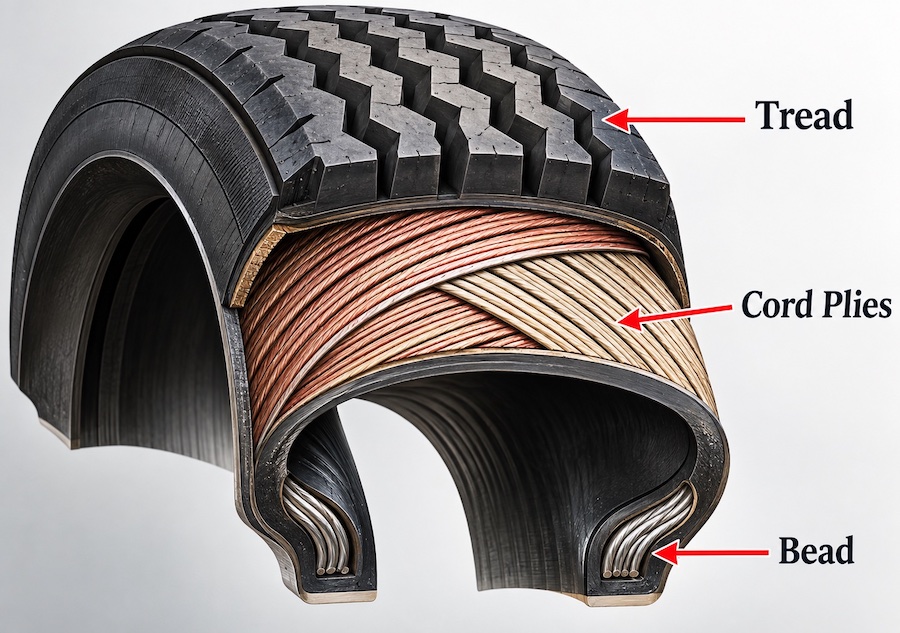
The two technologies therefore complemented rather than replaced one another. A Bentley tyre could be – and increasingly was – both wired-on and cross-ply.
By the later 1920s, therefore, the different developments were converging. Wired-on retention provided greater security on the rim; cross-ply construction provided a strong and resilient carcass; and increasingly generous tyre sections and lower pressures incorporated many of the principles associated with the “balloon” tyre.
- The arrival of the balloon tyre
The next major development concerned neither bead retention nor the direction of the carcass plies, but rather tyre volume and inflation pressure.
During the first decades of the twentieth century, roads were frequently surfaced with loose stone, left unpaved or laid with cobbles. Narrow, relatively high-pressure pneumatic tyres transmitted a considerable proportion of road shocks and vibrations through the suspension, steering and chassis.
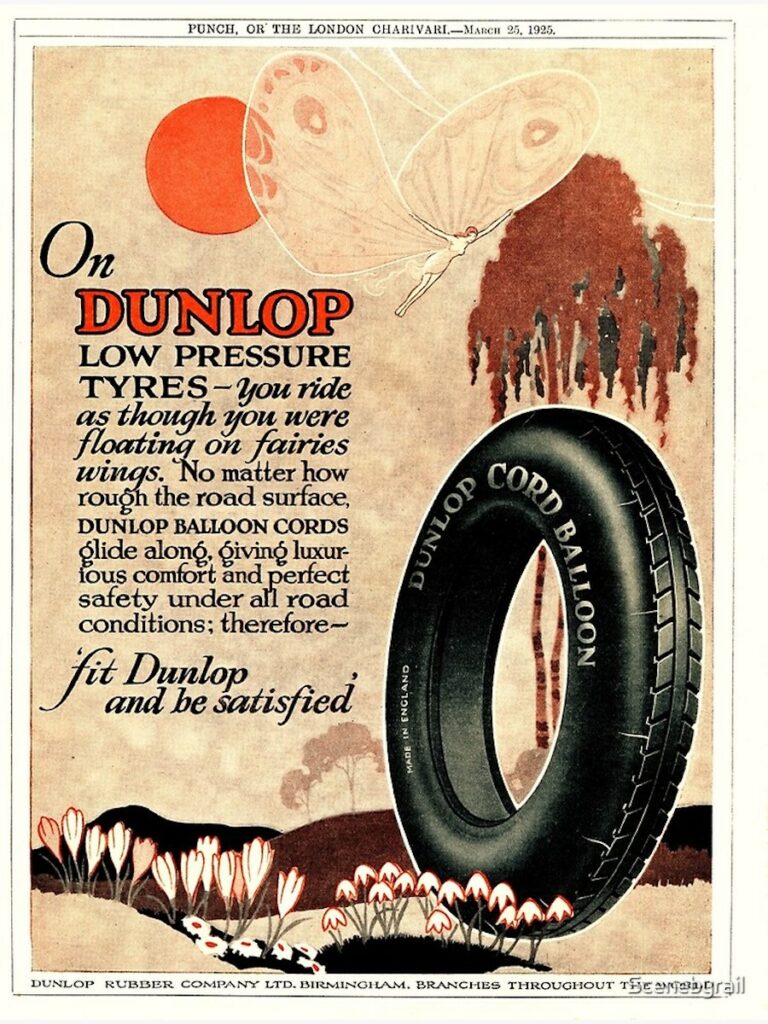
The balloon tyre represented one of the most important developments in automotive tyre technology during the 1920s. Instead of supporting a motor car on a relatively narrow tyre inflated to high pressure, engineers realised that a larger-volume, wider and more flexible tyre could support a comparable load at substantially lower inflation pressure.
The practical low-pressure balloon tyre was pioneered commercially in the United States by Firestone during the early 1920s. The concept rapidly influenced tyre development elsewhere, including Britain, where manufacturers such as Dunlop developed larger-section tyres suitable for increasingly heavy and powerful motor cars.
The breakthrough was therefore not simply a matter of “making the tyre wider”. The balloon-tyre concept brought together several related changes: larger tyre section + greater air volume + smaller-diameter rim + lower inflation pressure + a more flexible carcass.
This considerably improved the tyre’s ability to absorb road irregularities and helped isolate the motor car and its occupants from shocks and vibration. During the Bentley’s four consecutive victories at the 24 Hours of Le Mans between 1927 and 1930, all the Works cars were fitted with Dunlop tyres that included different tyre technologies:
– 1927: Bentley’s victorious 3 Litre Speed, “Old Number Seven” (chassis LM1344, registration MK 5206), driven by Dudley Benjafield and Sammy Davis, won after the famous White House crash had eliminated the other Works Bentleys. The car was equipped with 5.25 × 21 Dunlop straight-sided/wired-on cross-ply tyres.
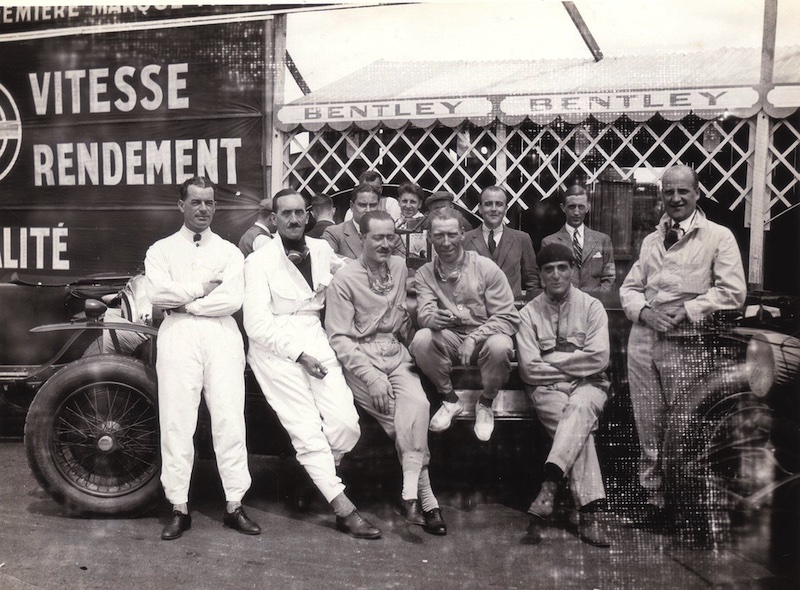
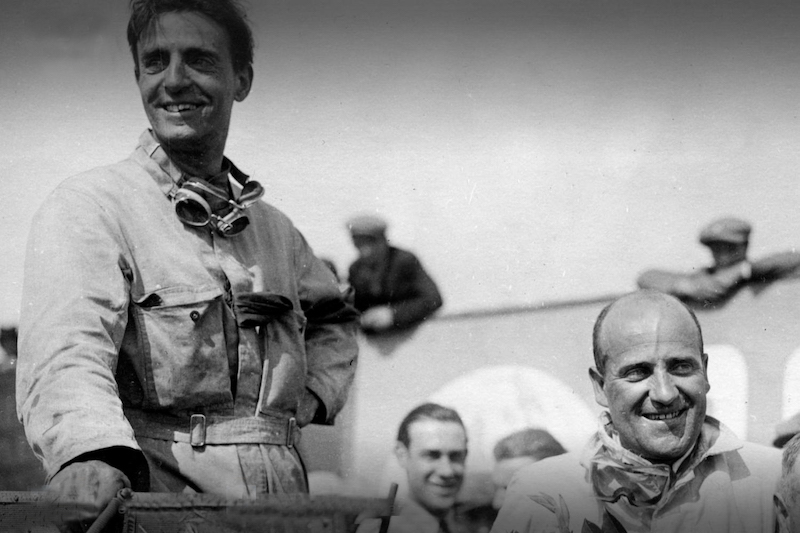
– 1928: the winning Works Bentley 4½ Litre “Old Mother Gun” (chassis ST 3001 – registration YH3196) of Woolf Barnato and Bernard Rubin ran on Dunlop tyres. Unlike the smaller 5.25 × 21 tyres fitted to road-going 4½ Litres, Bentley’s competition cars used substantially larger 6.75/7.00 × 21 tyres on 21-inch Rudge-Whitworth wire wheels. These were tube-type, straight-sided/wired-on cross-ply tyres, representing the large-section, lower-pressure tyre technology that was rapidly replacing the earlier high-pressure beaded-edge tyre during the second half of the 1920s.
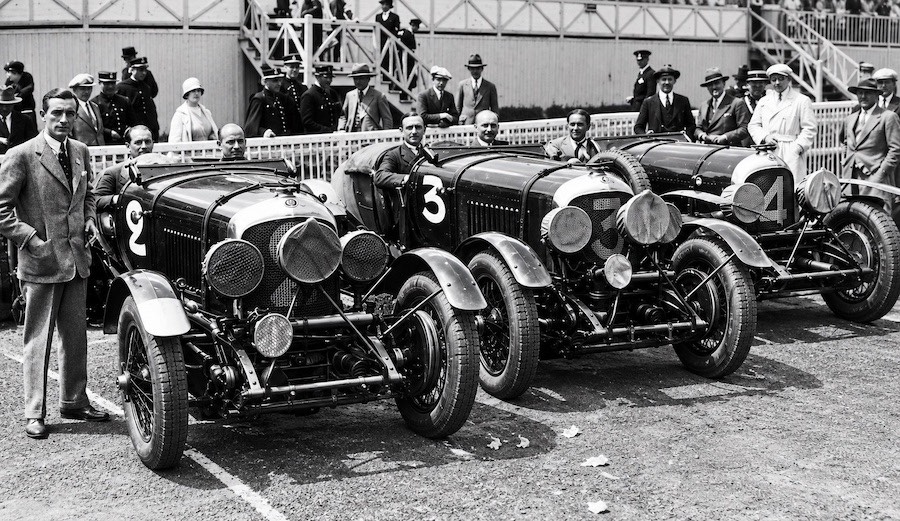
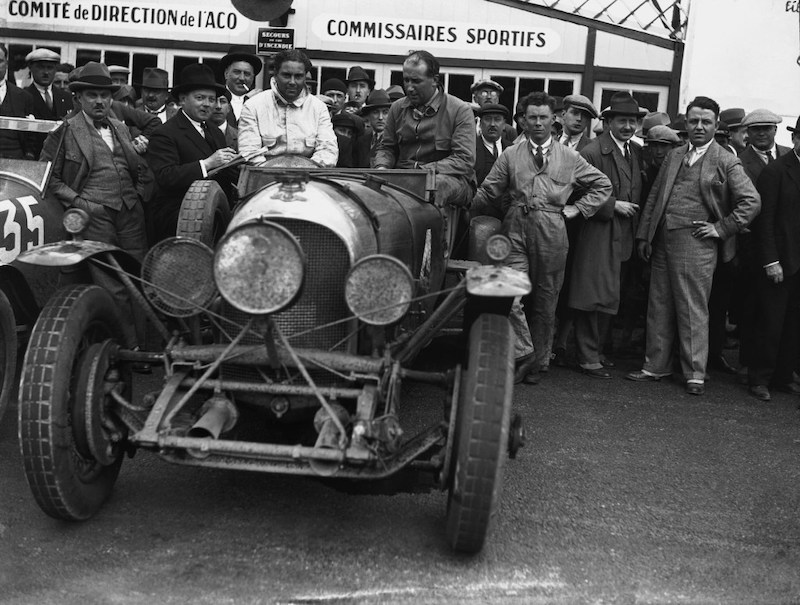
– 1929: this year marked the culmination of Bentley’s development of the large-section racing tyre before the final Works Le Mans campaign of 1930. Bentley Works cars again ran on Dunlop tyres, and the marque achieved an extraordinary first-to-fourth-place finish. The winning Speed Six (chassis LB2332 – registration MT 3464), driven by Woolf Barnato and Tim Birkin, is documented as having 32 × 6-inch “road-racing tyres” (normal 6½ Litre and Speed Six road-car tyres of the period were designated as 6.00 × 21).
The three Bentley 4½ Litres that followed the Speed Six home in second, third and fourth places were again fitted with substantially larger Dunlop competition tyres than those used on the production cars: once again, the famous Dunlops mounted on 21-inch Rudge-Whitworth wire wheels.
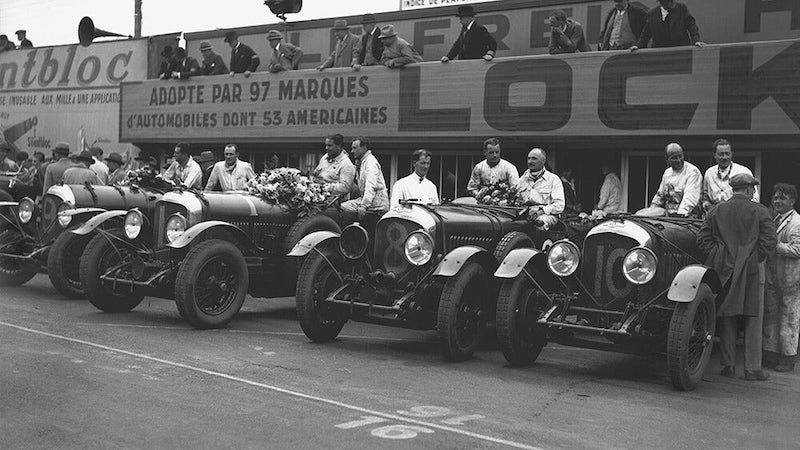
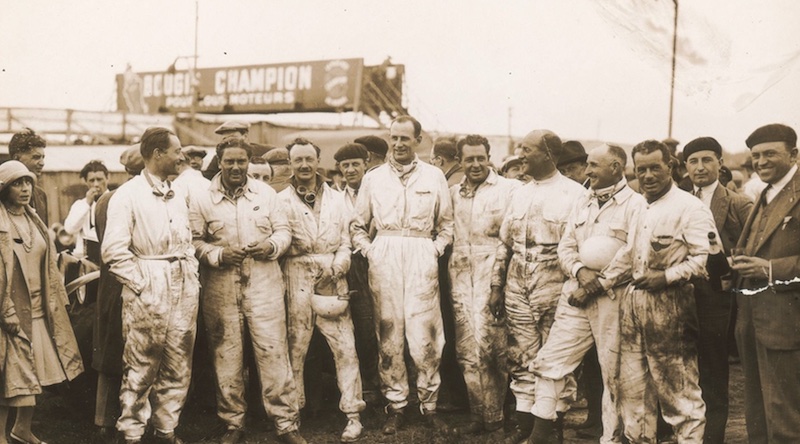
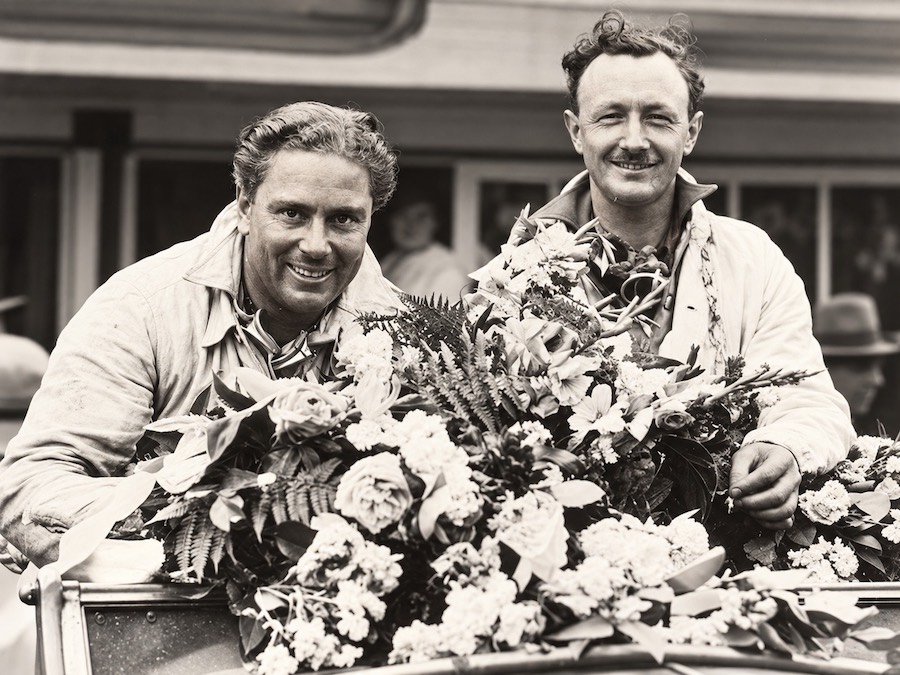
– 1930: Bentley’s final Works appearance at Le Mans brought the development of the Cricklewood racing tyre to its logical conclusion.
The factory entered three Speed Six team cars, all running on Dunlop tyres.
The previous year’s winning car, “Old Number One” (chassis LB2332 – registration MT 3464), driven by Woolf Barnato and Glen Kidston, won the race outright, covering 179 laps and 2,930.66 km. A second Works Speed Six (chassis HM2868 – registration GF 8507), driven by Frank Clement and Richard Watney, finished second, completing a Bentley one-two. The third Works Speed Six (chassis HM2869 – registration GF 8511), driven by Sammy Davis and Clive Dunfee, retired following an accident.
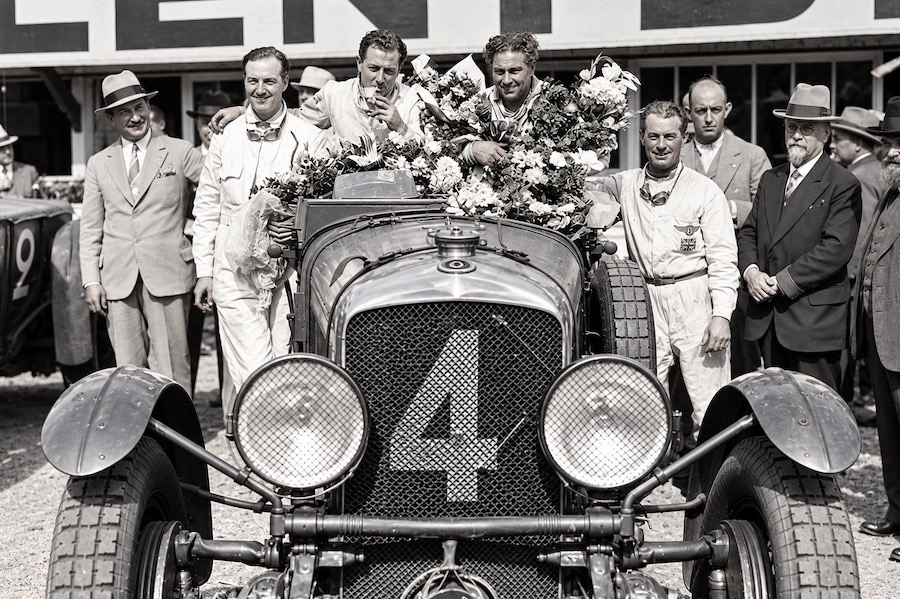
Bentley’s experience in motor racing between 1922 and 1930 perfectly illustrates a principle that would be demonstrated time and again over the following decades by many other automobile manufacturers: motor racing was not merely a showcase for demonstrating the performance of their cars. It also became an invaluable testing ground for tyre development.
Competition enabled automobile manufacturers and tyre manufacturers to work together, to identify the limits of their respective technologies, to experiment with new solutions and, progressively, to transfer these advances to production cars.
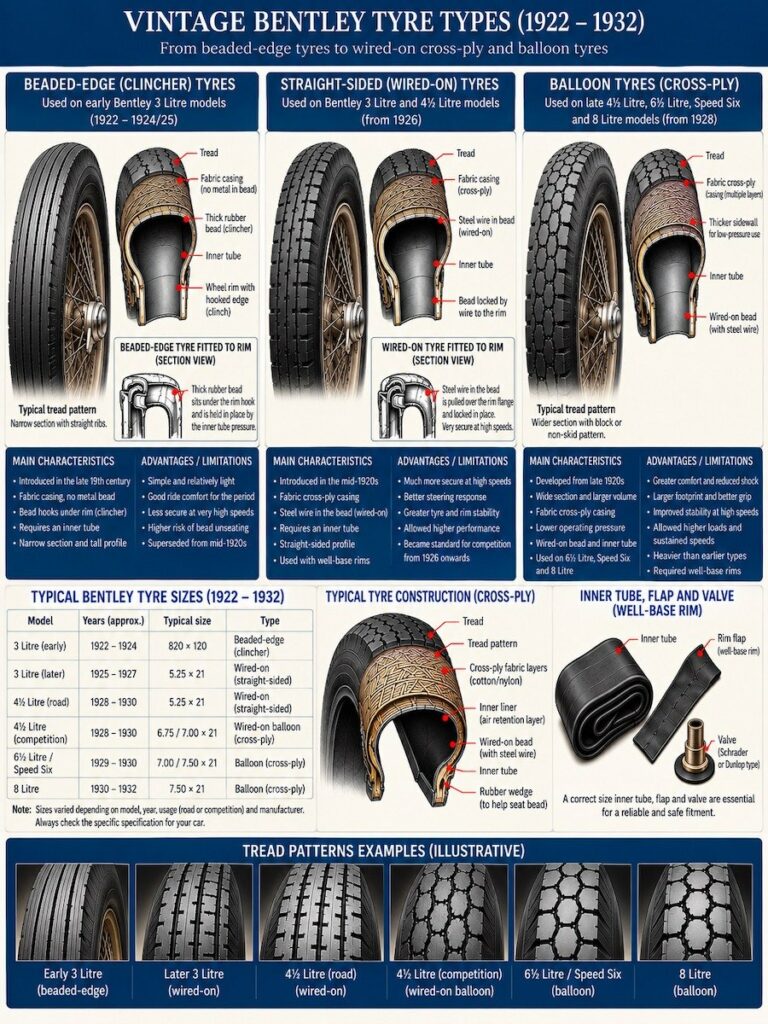
CARING FOR YOUR VINTAGE BENTLEY TYRES
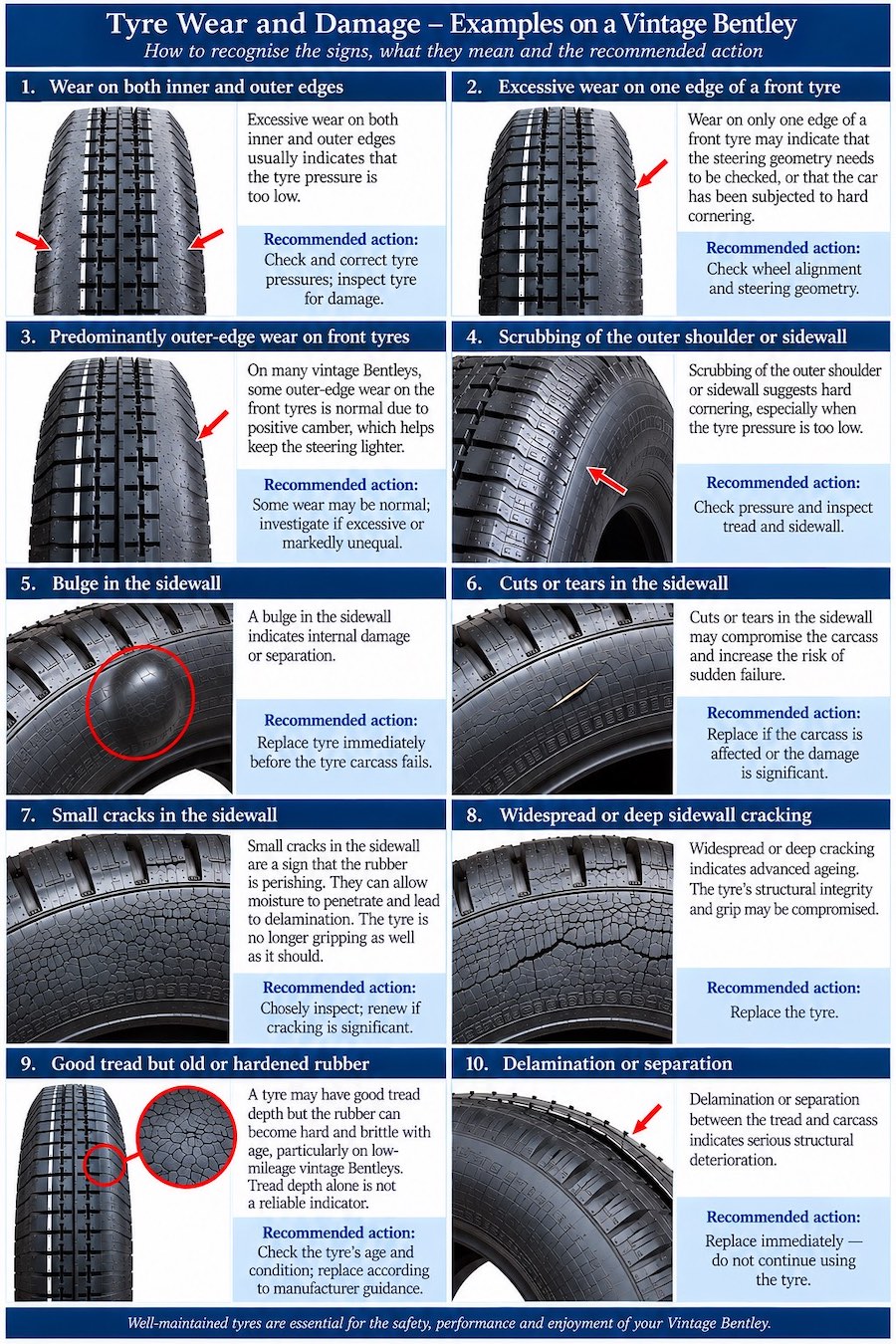
Although recommendations vary between tyre manufacturers and specialists, tyres fitted to Vintage Bentleys should be carefully monitored once they have been in service for around 5 years. For a pre-war car that is driven regularly, replacement after approximately 6 to 7 years may be considered a prudent precaution, particularly where the car is used for high-speed touring or competition. Regardless of tread wear or apparent external condition, 10 years from the date of manufacture should generally be regarded as the maximum service life of a tyre.
Over time, rubber compounds harden and lose their elasticity, while deterioration of the carcass and sidewalls can increase the risk of pressure loss or, in extreme cases, tyre failure. Exposure to sunlight and ultraviolet radiation, prolonged periods of storage, and repeated heating and cooling cycles can further accelerate the ageing process.
Tread depth alone should therefore never be used to determine whether an ageing tyre remains fit for continued use.
The table below will help readers better understand some of the key points to watch for when it comes to the tyres of a Vintage Bentley.