
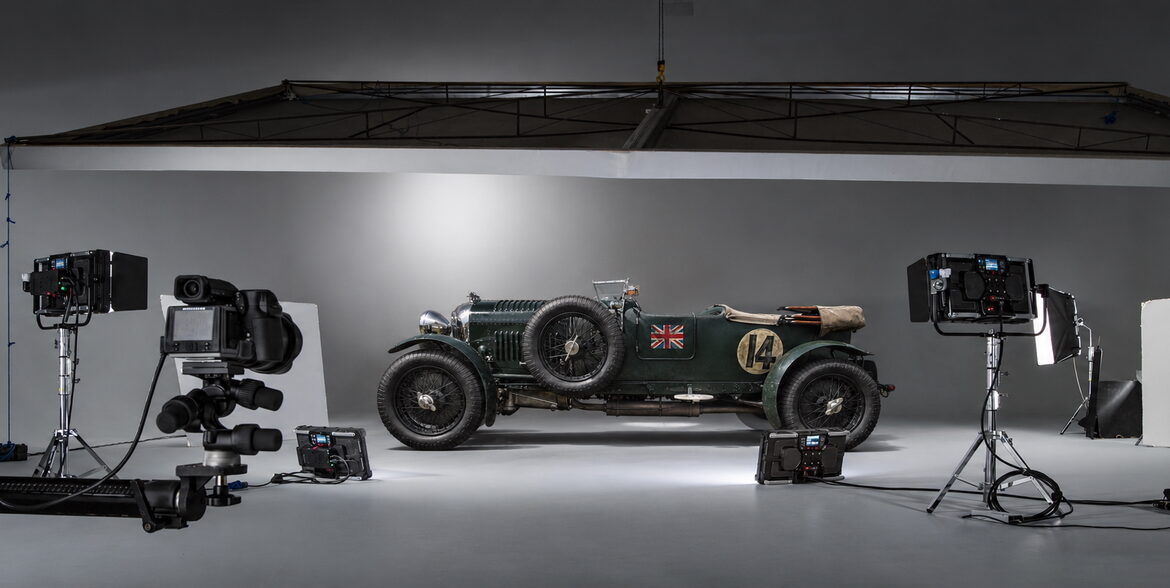
A friend of ours, a professional photographer specialising in automotive journalism and advertising, fell in love with our 1928 Bentley 4½ Litre Tourer. He is currently working on a photographic book devoted to pre-war motor cars, to be published as part of a prestigious collection. With this project in mind, he proposed a studio photoshoot to capture, almost a century after it was built, the timeless beauty, character and craftsmanship of what remains a genuine work of automotive art.
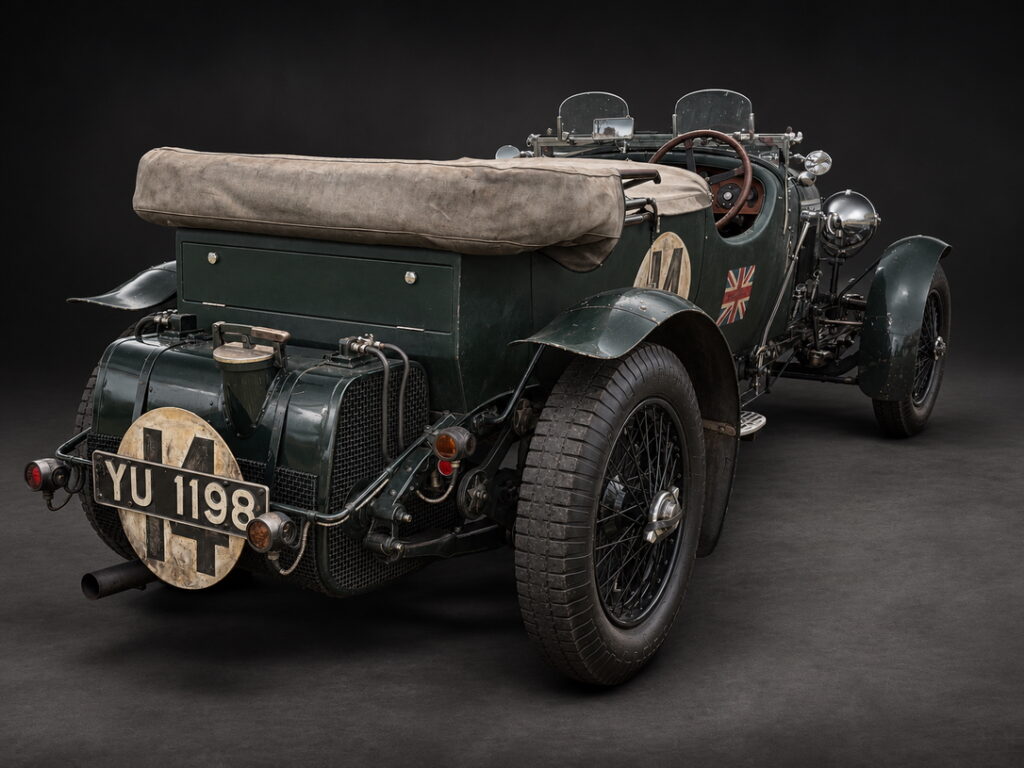
During the preparations, I soon realised that photographing our 1928 Bentley 4½ Litre Tourer – chassis XL 3104, registration YU 1198 – would be a particularly demanding undertaking. The aim was not simply to produce a beautiful photograph, but to preserve the car’s unique character and authenticity while revealing its lines, proportions, materials and mechanical details, without compromising its historical identity.
Behind an apparently simple studio photograph lie hours of preparation, meticulous lighting work and a genuine pursuit of aesthetic perfection.
Enhancing without altering
Unlike a modern car, whose surfaces tend to be smooth and relatively uniform, a Bentley from the 1920s displays an extraordinary variety of shapes and materials. Its long louvred bonnet, sweeping wings, imposing radiator, wire-spoked wheels, headlamps and numerous brass, nickel and chrome fittings all present their own photographic challenges.
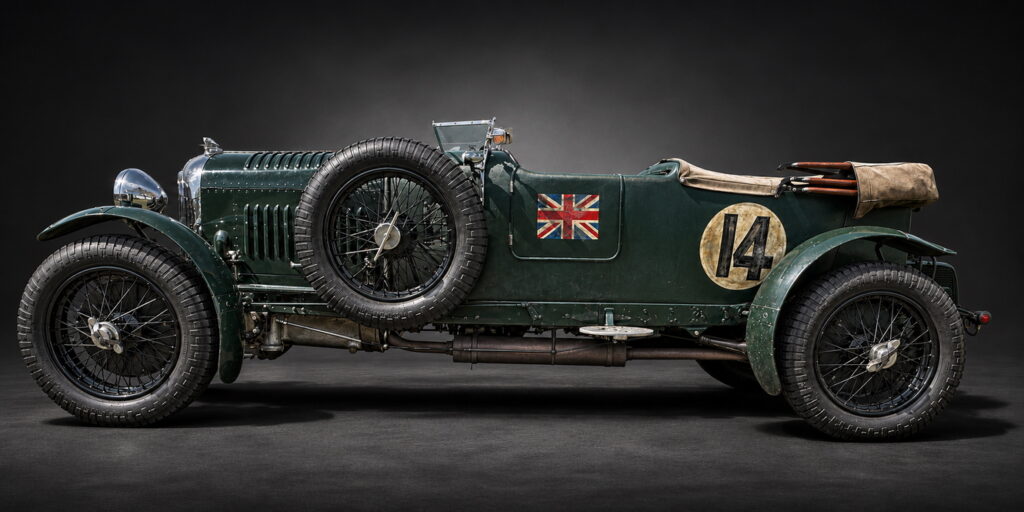
Choosing the right background allows the car to be isolated from its surroundings, drawing the viewer’s attention entirely to its silhouette. However, achieving a perfectly balanced image while retaining definition in the tyres, wings and darkest areas of the coachwork is particularly difficult. Too much light flattens the contours; too little causes important details to disappear into shadow.
The ambition, therefore, is to create an almost sculptural image in which every curve and mechanical component is given its rightful place.
Meticulous Preparation
Long before the first photograph is taken, the car must undergo thorough cosmetic preparation. Under powerful studio lighting, the slightest speck of dust, fingerprint or imperfection becomes immediately apparent. Cleaning the painted surfaces, metal fittings, wheels and tyres demands considerable attention to detail.
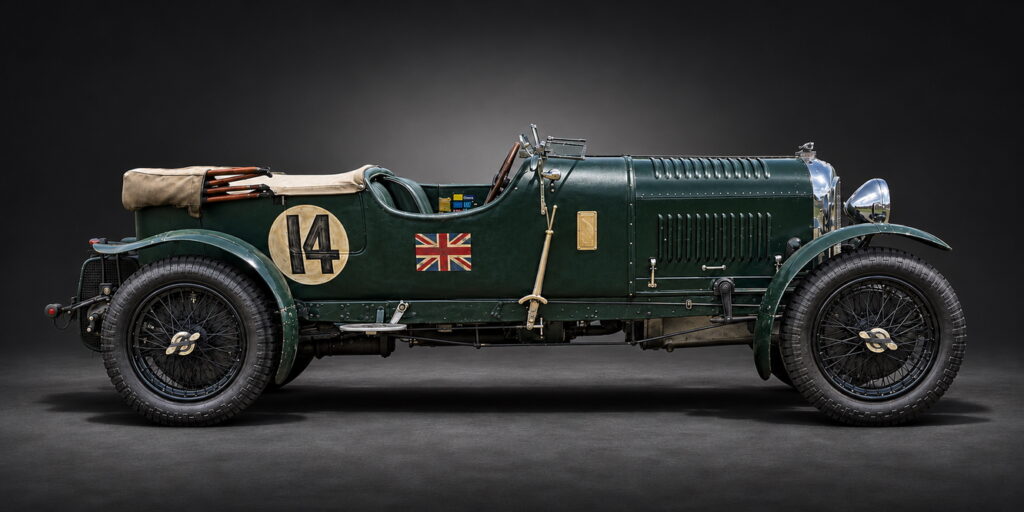
However, achieving a natural appearance sometimes means deliberately retaining certain traces of the car’s life on the road. For this particular photoshoot of chassis XL 3104, we intentionally left some dried mud on the wings, preserving a subtle reminder that this Bentley is very much a car that is driven and enjoyed, rather than merely displayed.
Positioning the Bentley presents another challenge. Given its considerable dimensions, weight and turning circle, moving the car by just a few centimetres can require several manoeuvres. The orientation of the wheels, the height of the camera and the choice of focal length must also be carefully considered to ensure that the car’s proportions are faithfully reproduced.
Preparing the studio itself can take several hours. Backgrounds, supports, reflectors and lighting equipment must all be positioned to allow access around the vehicle without introducing unwanted reflections.
Lighting: the real challenge
The greatest difficulty lies in controlling the light. A car’s bodywork behaves rather like an enormous curved mirror, reflecting the studio lights, equipment and sometimes even the photographer himself.
To manage these reflections, photographers use large diffusion panels, softboxes, reflectors and, where appropriate, polarising filters. Each light source serves a specific purpose: emphasising the curvature of a wing, revealing the bonnet louvres, picking out the spokes of a wheel or giving depth and definition to the radiator grille.
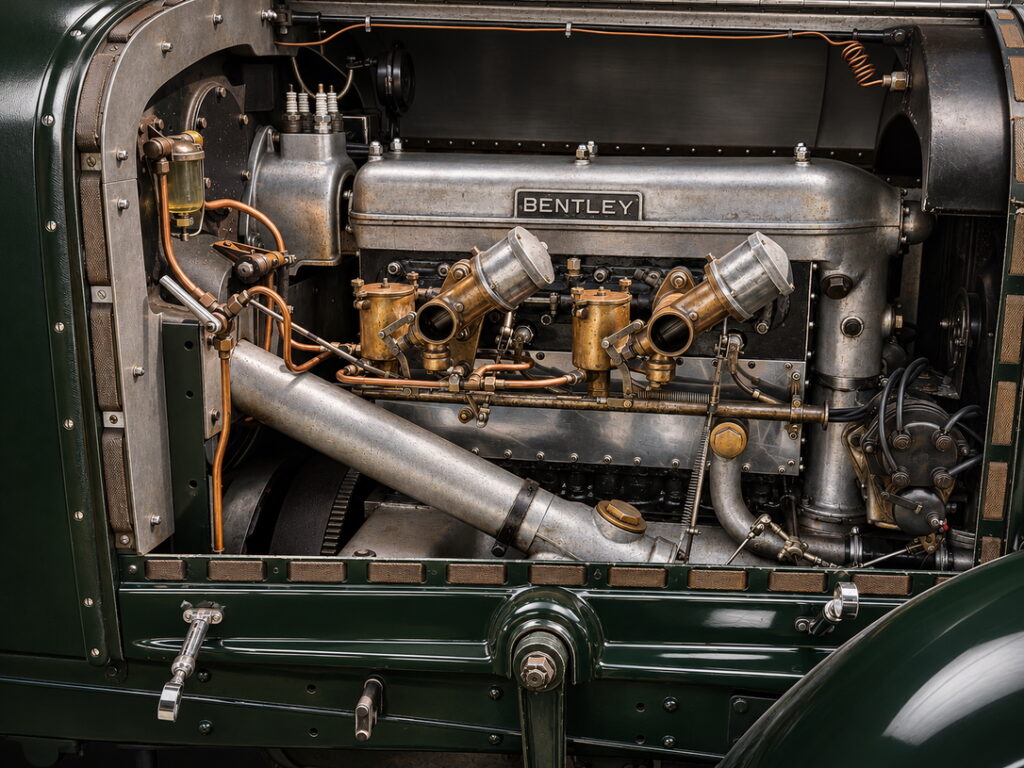
On a 1928 Bentley, this process is particularly delicate because of the combination of glossy, satin-finished and painted surfaces, some of which may also carry the patina of age.
Rather than attempting to illuminate the entire car at once, the photographer can work with successive lighting arrangements, taking several photographs from exactly the same camera position. One exposure might concentrate on the radiator, another on the wings, and a third on the wheels or cockpit.
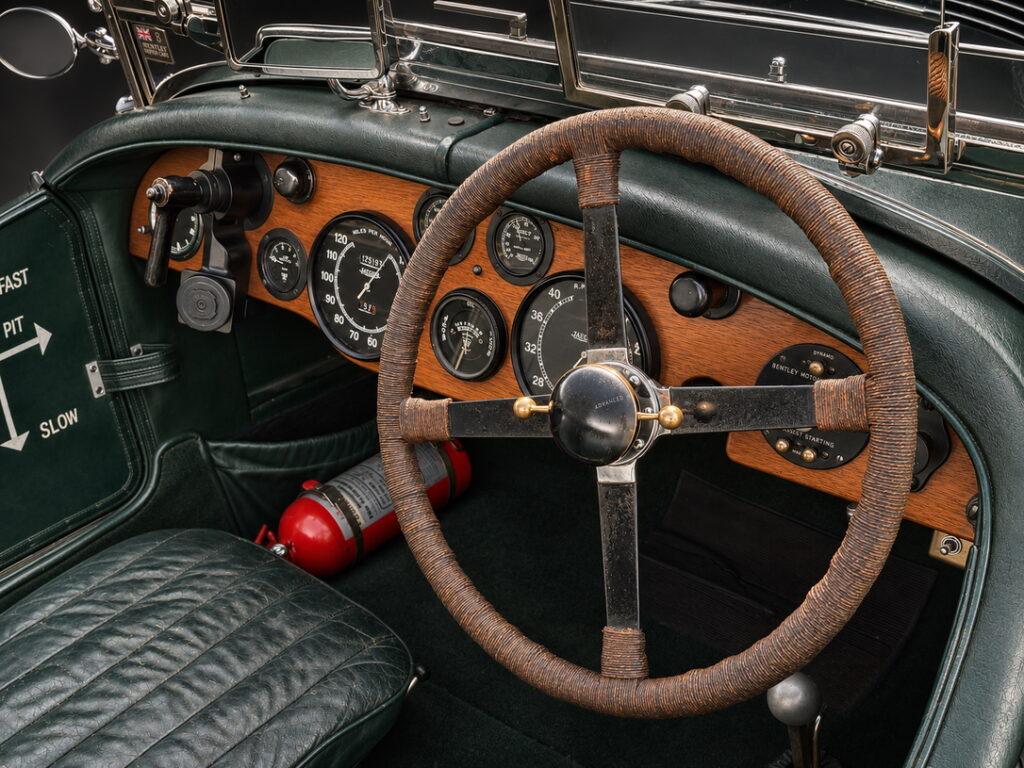
This technique allows each area to be controlled independently, achieving a level of precision that would be extremely difficult to obtain in a single exposure.
The invisible work of post-production
The photoshoot does not end when the Bentley leaves the studio. An equally important second stage then begins: post-production.
Using specialist software, particularly Photoshop and, increasingly, carefully targeted artificial intelligence tools, the photographer combines the different exposures using layers and masks. The best-lit areas are selected, contrasts are harmonised, colours adjusted and unwanted reflections removed.
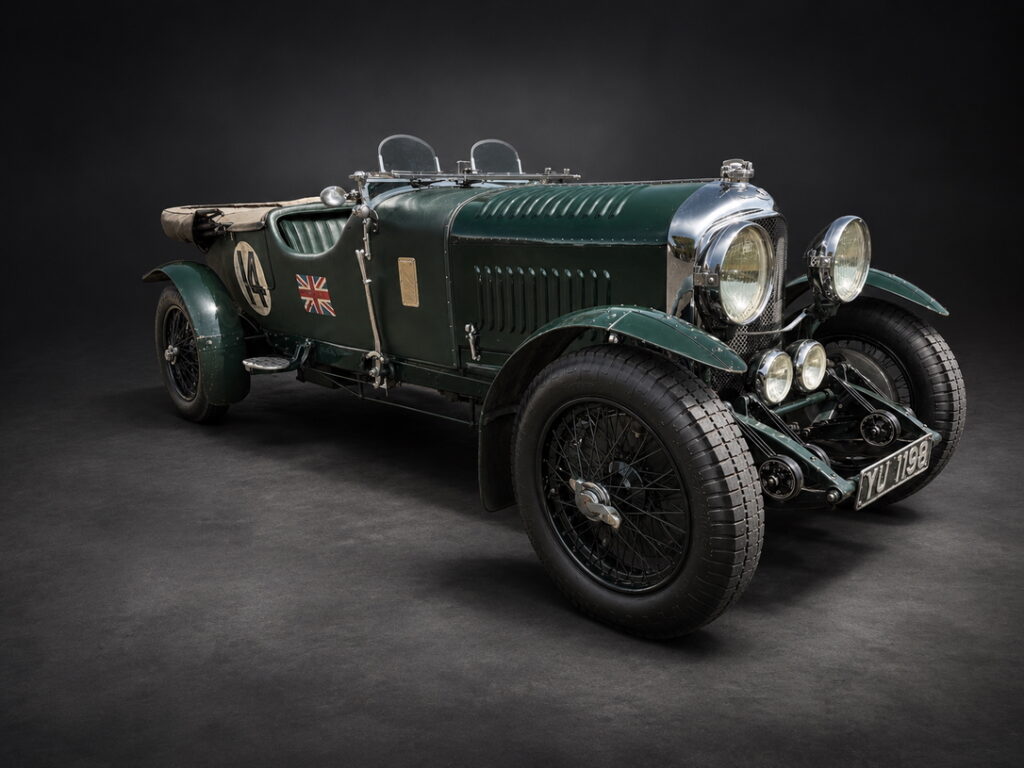
This process, sometimes referred to as light-painting compositing, produces a final image in which every detail appears to have been perfectly illuminated at precisely the same moment.
The challenge, however, is knowing when to stop. A successful photograph of a historic motor car should enhance its appearance, never alter its reality. Its proportions, period fittings, characteristic imperfections and patina must remain entirely faithful to the car itself.

Much more than just a photograph
Creating a photographic portrait of a 1928 Bentley 4½ Litre therefore requires a combination of technical expertise, artistic sensitivity and a genuine understanding of historic motor cars.
Behind a single finished image may lie dozens of exposures, countless lighting adjustments and several hours of painstaking retouching.
Yet the result goes far beyond mere aesthetics. As our Bentley approaches its centenary, we felt that it also deserved to be photographed from a historical and documentary perspective. Each image becomes a detailed record of its condition, coachwork and mechanical characteristics at a particular moment in its history.

Ultimately, the success of such a photoshoot lies in a paradox: the more complex the photographer’s work, the less apparent it should be. The viewer should see neither the lighting equipment, nor the retouching, nor the many hours of preparation.
Only a beautifully illuminated 1928 Bentley, whose elegance and authenticity speak entirely for themselves.